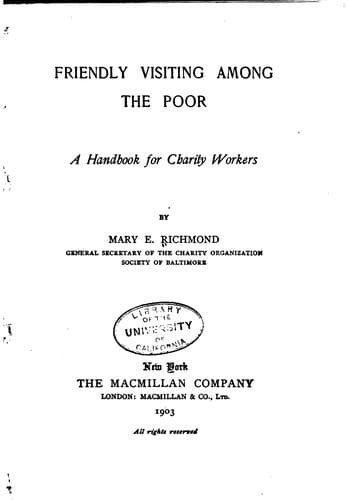
Friendly Visiting among the Poor: A Handbook for Charity WorkersRichmond, Mary Ellen
General
Friendly Visiting among the Poor: A Handbook for Charity Workers
Richmond, Mary Ellen
Friendly visiting
the doctor, too, we should stand ready to change our plan of treatment
when conditions change. "In one family, where a pension was given on
account of the breadwinner's illness, and continued for six weeks after
his death, the daughters have been unwilling to take work offered at
wages they thought too low, because they were not thrown upon their own
resources at once." [3]
A plan that is not based upon the actual facts is, of course, worse
than useless. Sometimes a charitable person will call at a home for
the first time, will see miserable surroundings, and will feel that the
circumstances are all made plain to him in one visit. Calling at a
relief office, he will urge immediate relief, adding, "I have
investigated the case myself." {156} The word "investigation" means
very different things to different people. Here are some of the
questions that, according to the London "Charity Organization Review,"
[4] an almoner should ask himself about any given case:
"1. Can anything be done to increase the family income? Can the number
of wage-earners be added to? Can those doing badly paid work be taught
better-paid work? Can they be put in the way of getting better tools
or appliances?
"2. Can anything be done to make the existing income go farther than it
goes now? e.g.
"(_a_) Is too much money paid away in rent? Could as good
accommodations be obtained in the district elsewhere for less? Or
could the family do with less accommodation.
"(_b_) Is money wasted? _e.g._ on medicine, or in habitual pawning, or
in purchasing from tallymen, or in buying things not wanted? Do
husband and children keep back an undue share of their earnings?
"(_c_) Is too much money spent in travelling {157} backwards and
forwards to place of employment? If so, could the family move nearer
to their work without increasing their rent?
"These are but a few of the questions which the almoner must put if he
wishes to be thorough. In every case he must _think_ about the problem
with which he is dealing, and he must try to make those who are
applying for help think also."
The best arguments for giving relief upon a definite plan are the
results of haphazard benevolence that are all around us--feeble-minded
women with illegitimate offspring, children crippled by drunken
fathers, juvenile offenders who began as child-beggars, aged parents
neglected by their children. Every form of human weakness and
depravity is intensified by the charity that asks no questions.
_The third relief principle is that relief should look not only to the
alleviation of present suffering, but to promoting the future welfare
of the recipient._
IV. It follows from the foregoing that when we relieve at all we
should relieve adequately.
Public-domain text, read in full here on John Shaqi.
Reviews
Reviews
No reviews yet
Be the first to share your thoughts on this work.
Elsewhere in the archive
Join the Discussion
Join the discussion
Sign in to leave a comment or review.
Sign InorCreate an account