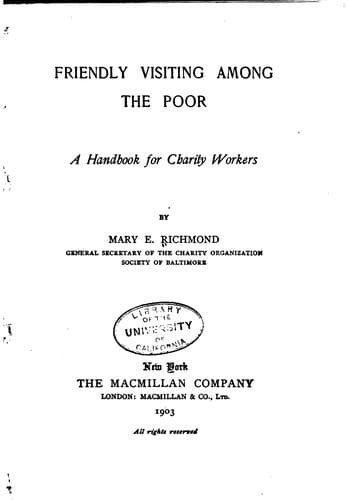
Friendly Visiting among the Poor: A Handbook for Charity WorkersRichmond, Mary Ellen
General
Friendly Visiting among the Poor: A Handbook for Charity Workers
Richmond, Mary Ellen
Friendly visiting
"A friend of mine," writes a London charity worker, "heard two very
respectable women talking. One said, 'Well, Mrs. Smith, how have you
fared this Christmas?' 'Oh, very badly; I had very little relief.'
The other replied: 'Well, Mrs. Smith, it is all your own fault; you
will go and sit in the side aisle of the church, where nobody ever sees
you. If {168} you would sit in front, you would be helped as we all
are.'" Writing of conditions too common in America, Rev. George B.
afford says: "Families transfer their connection from one church to
another, or, with an impartiality rare in other relations, distribute
their representatives among several Sunday-schools or churches, gaining
by pseudo-devout arts what they can from each: Methodist clothing;
Baptist groceries; Presbyterian meat; Episcopalian potatoes; Roman
Catholic rent; Universalist cash, available for 'sundries,'--all are
acceptable to the mendicant pensioner of religious charity. One
family, now at last well advertised, in an eastern city found its
numerous youthful progeny effective leeches as applied to the several
Sunday-schools among which they were distributed. The 'widowed' mother
underwent frequent conversion; the children enjoyed the benefit of as
frequent baptism. On a certain gathering of clergymen of different
churches, when one after another had told the story of his
discomfiture, all joined to congratulate the single representative of
the Baptist denomination present on his happy escape {169} from the
imposture, under which several others had in turn baptized the
children. But from him came the sad confession that he had baptized
the woman herself." [1] In my own city, a family made a small child
not their own a source of income by having it baptized frequently in
different churches, so that three charitable members of three Episcopal
churches were astonished to find, on comparing notes, that they shared
the responsibility of being the child's godmothers.
But it is needless to multiply illustrations; almost every church has a
collection of such experiences, and the bad effects of successful
deception upon the deceivers are apparent enough. I pass to the
important fact that this class of the poor, though numerically
insignificant by comparison with the poor in general, are yet so much
in evidence as the objects of Christian zeal, and the church wastes so
much time in coddling them, that the self-respecting poor often hold
aloof. It is a common thing to hear a poor man say that he is not
going to attend church, and be suspected of {170} trying to get
something. It does not increase his respect for Christians to find
them easily deceived, and it outrages his sense of justice to see that
laziness, drunkenness, and vice are rewarded by church workers. Even
among tramps, the variety known as the "mission bum" is looked down
upon by his fellows, and there is a lesson for the mission worker in
this simple fact.
Public-domain text, read in full here on John Shaqi.
Reviews
Reviews
No reviews yet
Be the first to share your thoughts on this work.
Elsewhere in the archive
Join the Discussion
Join the discussion
Sign in to leave a comment or review.
Sign InorCreate an account