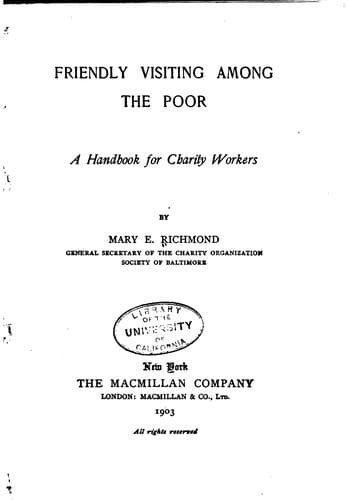
Friendly Visiting among the Poor: A Handbook for Charity WorkersRichmond, Mary Ellen
General
Friendly Visiting among the Poor: A Handbook for Charity Workers
Richmond, Mary Ellen
Friendly visiting
In writing thus frankly of home missionary work, I am not unmindful of
all the difficulties with which Christian ministers have to contend.
Many of them are as much alive to the dangers of indiscriminate relief
as any one can be, and many of them have risked unpopularity and
misunderstanding to lift their churches out of the tread-mill of
ineffectual, dole-dispensing charities into vital contact with the
needs of the poor. The difficulties of Christian ministers are
twofold. Their first duty is to develop the charitable instincts of
church members, to overcome the selfishness and inertia of the natural
man. When they have succeeded in arousing a desire to do something for
somebody else, they must also furnish ample opportunity for {171} the
exercise of this newly awakened impulse. Now the charitable
development of the individual follows the development of the race; the
individual outgrows slowly, if at all, the sentimental and patronizing
view of poverty. To carry church members beyond this phase and make
them effective workers, genuine powers of leadership are needed, and it
is much easier to let them follow their own devices. We have seen in
the last chapter that relief work, if well done, is the most difficult
of all charitable work, but nine inexperienced workers out of every ten
will think it the best and easiest means of helping the poor--the only
means, in fact.
A difficulty to be reckoned with, and yet one with which it is hard to
have any patience, is the rank materialism that regards relief as a
legitimate means of attracting people to the church. Relief as a
gospel agency has done far more harm than good: you cannot buy a
Christian without getting a bad bargain, and yet, competition among
rival churches working in the same poor neighborhood is so sharp that
even now, in these days of cooperative {172} effort, we find that the
sordid appeal is made. "I call it waste," wrote the late Archbishop of
Canterbury, "when money is laid out upon instinct which ought to be
laid out upon principle, and waste of the worst possible kind when two
or three religious bodies are working with one eye to the improvement
of the condition of those whom they help, and with another eye directed
to getting them within the circle of their own organization. When each
of those religious bodies does so work, say upon a single large family,
and, feeling quite sure of one member of the family, nourishes great
hopes of the rest of the members of the family that they will become
true and orthodox members of their own community, I call that not only
waste--I call it demoralization of the worst conceivable kind, for a
reason which the poet puts thus, 'What shall bless when holy water
banes?' The demoralization produced is the worst possible, because the
highest possible thoughts are used as mere instruments for low ends."
[2]
{173}
Public-domain text, read in full here on John Shaqi.
Reviews
Reviews
No reviews yet
Be the first to share your thoughts on this work.
Elsewhere in the archive
Join the Discussion
Join the discussion
Sign in to leave a comment or review.
Sign InorCreate an account