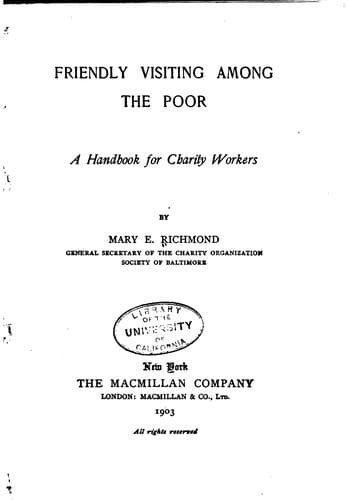
Friendly Visiting among the Poor: A Handbook for Charity WorkersRichmond, Mary Ellen
General
Friendly Visiting among the Poor: A Handbook for Charity Workers
Richmond, Mary Ellen
Friendly visiting
In avoiding the danger of representing friendly visiting as a pleasant
diversion, I may have gone to the other extreme, and represented it
rather as an arduous and {180} exacting profession. It is so far from
being this, that professional visiting can never be friendly. In fact,
friendly visiting is not any of the things already described in this
book. It is not wise measures of relief; it is not finding employment;
it is not getting the children in school or training them for work; it
is not improving sanitary arrangements and caring for the sick; it is
not teaching cleanliness or economical cooking or buying; it is not
enforcing habits of thrift or encouraging healthful recreations. It
may be a few of these things, or all of them, but it is always
something more. Friendly visiting means intimate and continuous
knowledge of and sympathy with a poor family's joys, sorrows, opinions,
feelings, and entire outlook upon life. The visitor that has this is
unlikely to blunder either about relief or any detail; without it, he
is almost certain, in any charitable relations with members of the
family, to blunder seriously. Visitors have said to me that they could
not see that they had been of any special service, though their
friendly feeling for certain families made it impossible to stop
visiting. These visitors {181} who have no story to tell have often
done the greatest good. "One of the women we had not seen since she
first came to us some four years before," writes Miss Frances Smith,
"and we remembered her distinctly as quite ordinary then. Imagine our
surprise in finding that a certain dignity and earnestness, akin to
that of the visitor, had crept into this woman's life, and found
expression in her face and bearing. Such transfigurations cannot take
place in a few weeks or months; they are of slow growth, but they are
the best rewards of friendship." [1]
The rewards of friendly visiting and the best results of such work are
obviously not dependent upon the suggestions of a handbook. As Miss
Octavia Hill has said, success in this depends no more on rules than
does that of a young lady who begins housekeeping. "Certain things she
should indeed know; but whether she manages well or ill depends mainly
upon what she is." Life, therefore, is the best school.
Meddlesomeness, {182} lack of tact, impatience for results,
carelessness in keeping engagements and promises, will be as fatal here
as anywhere.
Public-domain text, read in full here on John Shaqi.
Reviews
Reviews
No reviews yet
Be the first to share your thoughts on this work.
Elsewhere in the archive
Join the Discussion
Join the discussion
Sign in to leave a comment or review.
Sign InorCreate an account