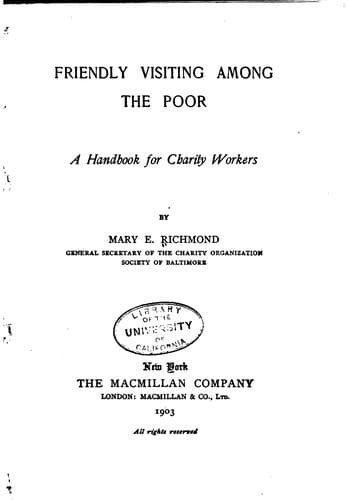
Friendly Visiting among the Poor: A Handbook for Charity WorkersRichmond, Mary Ellen
General
Friendly Visiting among the Poor: A Handbook for Charity Workers
Richmond, Mary Ellen
Friendly visiting
When we are depressed by a family's troubles and are striving earnestly
to find a way out, theirs seem quite unlike any other troubles. In a
sense, it is true that they are unlike; but there are certain
resemblances between human beings, even when a continent divides them;
and, unsafe though it may be to administer charity by rule, it is more
unsafe to administer it without reference to certain general
principles. Many of the suggestions of this book are not of universal
application, but, in bringing it to a close, I shall endeavor to state
a few principles that apply quite universally to friendly visiting.
1. The friendly visitor should get well acquainted with all the
members of the family without trying to force their confidence. A
fault of beginners is that they are unwilling to wait for the natural
development of trust and friendliness. "They expect to make a half
dozen visits on a poor family inside of a month," says Miss Birtwell,
"and see them {183} helped. Now, which one of us ever had our lives
strongly influenced by a friendship of a month's standing? . . . I
once heard a sermon which made an impression on my mind that has
remained with me for years. One of its main ideas was to get your
influence before you used it. Many people seem to think that if they
can visit a poor family, by virtue of their superior education and
culture, they must immediately have a very strong influence. They do
not get it that way. They must get it just as our friends get an
influence over us, by long, patient contact, and by the slow, natural
growth of friendship." [2]
Patience is difficult where we see so many things to be done, and it is
particularly difficult where there is actual need; but the visitor does
not go to act as a substitute for the forces, charitable or other, that
have kept the family alive so far. He must confer with sources of
relief that are or can be interested, but beyond this he must have the
courage to {184} do nothing until he knows what is the right thing to
do.
It is not possible to visit many families, but there are definite
advantages in visiting more than one--the usual limit should be not
less than two nor more than four. An advantage in visiting two
families is that the visitor is less likely to be feverishly active
during the earlier stages of acquaintance, and the contrasts and
resemblances between the two give the visitor a better grasp of
principles. Not only is a new visitor liable to err in overvisiting a
family, but some families have too many charitable visitors. The New
York visitor, who refused to go to a family on whom three charity
workers had lately called, was wise. There are families so clearly
overvisited that all who are charitably interested in them should be
persuaded to let them alone for a while.
Public-domain text, read in full here on John Shaqi.
Reviews
Reviews
No reviews yet
Be the first to share your thoughts on this work.
Elsewhere in the archive
Join the Discussion
Join the discussion
Sign in to leave a comment or review.
Sign InorCreate an account