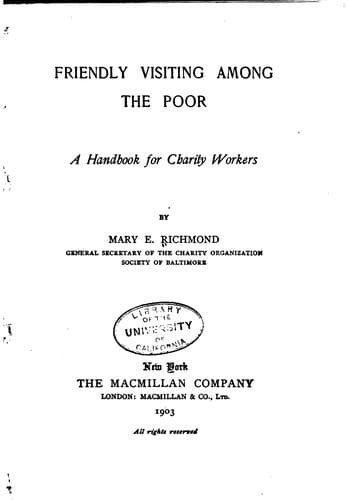
Friendly Visiting among the Poor: A Handbook for Charity WorkersRichmond, Mary Ellen
General
Friendly Visiting among the Poor: A Handbook for Charity Workers
Richmond, Mary Ellen
Friendly visiting
It ought to be unnecessary to add that the winter is not the only time
for charitable work. Our poor friends need us quite as much in summer,
though many charities are less active then. When we are away in summer
we can {185} write, and when we are in town for a short while we can
often find time for a visit. Charitable work suffers from the
tradition that the only time to be charitable is when it is cold.
Next to uninterrupted visiting as a means of getting acquainted, comes
the power of taking our own interests with us when we visit. "In our
contact with poor people we do not always give ourselves as generously
as we might. Intent upon finding out about them, we forget that they
might be interested to hear about us. Would it not be well if, instead
of always giving sympathy, we sometimes asked it? It is often
striking, if we tell them about the joys and sorrows of our friends, to
note how they respond, often inquiring about them afterward. Such
mutual relationship broadens their meagre lives, and makes our contact
with them more human. A visitor, who has undertaken during the summer
the families of another too far away to visit, wrote: 'I want to tell
you what a matter of interest and pleasure it has been to me, in
visiting your families, to find that what they {186} really seemed to
value was your personal friendship for them, and how they treasured any
little incident you had told them of yourself and your travels.'" [3]
One who visits in this spirit always wins more of pleasure and of
profit from the work. In fact, it is never the visited only that are
benefited.
2. In getting acquainted, the visitor has the definite object of
trying to improve the condition of the family. This is impossible
unless he has a fairly accurate knowledge of the main facts of the
family history. Charity workers often come to me for advice about
individual families, and reveal in a few minutes' conversation that
they have no knowledge of the condition of those they would help. The
head of the family is sick, it may be, and they expect prompt advice as
to the best way to help him; but they have not taken the trouble to see
the dispensary doctor who attends him, or to find out in some other way
the nature of his disease; or perhaps the boy is out of work, but they
have not seen his {187} former employer and know nothing of his earning
capacity or references. Charitable skill is not a sort of benevolent
magic; it is based on common sense, and must work in close contact with
the facts of life. In other friendly relations we recognize this, and
in our charity work too, whether by investigation of a trained agent or
by our own inquiries, we must have the facts before we can find out the
best way to help. One advantage of visiting under the guidance of a
charity organization society is that a thorough investigation has been
made of the family circumstances before the visitor is sent.
Public-domain text, read in full here on John Shaqi.
Reviews
Reviews
No reviews yet
Be the first to share your thoughts on this work.
Elsewhere in the archive
Join the Discussion
Join the discussion
Sign in to leave a comment or review.
Sign InorCreate an account