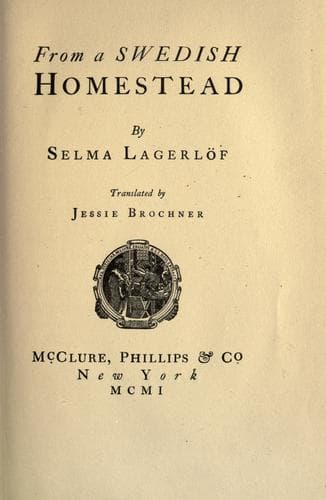
Short stories, Swedish -- Translations into English; Sweden -- Social life and customs -- Fiction
She could, perhaps, have done this, but she would not. She was already
displeased because Hede went about with a pack and looked like a
peasant; she thought that for that reason alone it was difficult to love
him as much as before. Now, when he told her that he must still go on
doing this for many years, she said that she could no longer wait for
him. This last blow was too much for Hede; his mind gave way.
He did not grow quite mad, however; he retained so much of his senses
that he could attend to his business. He even did better than others,
for it amused people to make fun of him; he was always welcome at the
peasants' houses. People plagued and teased him, but that was in a way
good for him, as he was so anxious to become rich. And in the course of
a few years he had earned enough to pay all his debts, and he could have
lived free from worry on his estate. But this he did not understand; he
went about half-witted and silly from farm to farm, and he had no longer
any idea to what class of people he really belonged.
III
Raglanda was the name of a parish in the north of East Vermland, near
the borders of Dalarne, where the Dean had a large house, but the pastor
only a small and poor one. But poor as they were at the small parsonage,
they had been charitable enough to adopt a poor girl. She was a little
girl, Ingrid by name, and she had come to the parsonage when she was
thirteen years old.
The pastor had accidentally seen her at a fair, where she sat crying
outside the tent of some acrobats. He had stopped and asked her why she
was crying, and she had told him that her blind grandfather was dead,
and that she had no relatives left. She now travelled with a couple of
acrobats, and they were good to her, but she cried because she was so
stupid that she could never learn to dance on the tight-rope and help to
earn any money.
There was a sorrowful grace over the child which touched the pastor's
heart. He said at once to himself that he could not allow such a little
creature to go to the bad amongst these wandering tramps. He went into
the tent, where he saw Mr. and Mrs. Blomgren, and offered to take the
child home with him. The old acrobats began to weep, and said that
although the girl was entirely unfitted for the profession, they would
so very much like to keep her; but at the same time they thought she
would be happier in a real home with people who lived in the same place
all the year round, and therefore they were willing to give her up to
the pastor if he would only promise them that she should be like one of
his own children.
Public-domain text, read in full here on John Shaqi.
Reviews
Reviews
No reviews yet
Be the first to share your thoughts on this work.
Join the Discussion
Join the discussion
Sign in to leave a comment or review.
Sign InorCreate an account