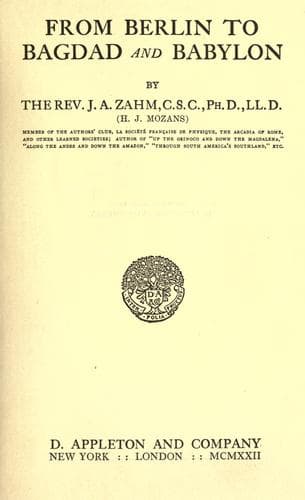
From Berlin to Bagdad and BabylonZahm, J. A. (John Augustine)
HistoryChristian
From Berlin to Bagdad and Babylon
Zahm, J. A. (John Augustine)
Middle East -- Civilization; Middle East -- Description and travel
Dr. von Siemens was not only one of the ablest of the group of eminent
men whom the Kaiser had gathered about him, but was also a great
favorite of the German War Lord. He not only shared von Moltke’s views
regarding the development of Asia Minor and Mesopotamia, but, with rare
clearness of vision, saw that this development could be achieved only
by the construction of a railway through the broad wastes which lay
between the Bosphorus and the Persian Gulf. To reclaim for civilization
the long-neglected valleys of the Euphrates and the Tigris and to
restore to their ancient splendor the broad and fertile plains of
Anatolia and Mesopotamia--so long the favored home of humanity--became
his dominant ambition, and to the achievement of his cherished project
he directed for years, with marvelous address and persistency, his
indomitable energy and _savoir faire_. Slowly but surely his dream
began to be realized.
Before the Anatolian Railway was completed the Turkish Army was eating
bread made from Russian flour; now it is using grain grown in the
fertile acres of Asia Minor. And before the advent of the railroad the
communications between the interior of Asia Minor and the seaboard
were so wretched that the freight on domestic grain was greater than
on that imported from Russia or the United States. The result was that
the Anatolian peasants then grew only enough wheat for their own needs.
Before the advent of the railroad not a single ton of grain from the
region traversed by the Anatolian Railroad reached the seacoast for
export. After the road was completed the export of wheat and other
cereals became, in a very short time, an important item of commerce.
The peasantry received “for their harvests from twice to four times the
prices formerly paid and the railways brought revenue to the (Ottoman)
treasury.”[155]
The cost of the railway was great, indeed, but greater far was its
value to Turkey, for it was not only the best but also the only
practical means of “bringing the disjointed members of that large
empire within reach of control,” and of “bringing security and
cultivation, order and civilization, to a country that once had been
the most fertile on earth.”[156]
That Germany should have received the concession for building the
Bagdad Railway in the face of such strong competitors as Russia,
France, and England was a great surprise to those who were not
familiar with the relations among the Great Powers and who were not
well informed respecting the diplomatic game as it was then played in
Constantinople. To those, however, who had an accurate knowledge of
the strained relations which existed between the Porte and certain of
the western nations and who knew how suspicious Abdul-Hamid II was of
all schemes affecting Turkey, which were engineered in Russia or Great
Britain, or in behalf of Russian or British interests, the outcome of
the long diplomatic game at the Porte was looked upon as a foregone
conclusion.
Public-domain text, read in full here on John Shaqi.
Reviews
Reviews
No reviews yet
Be the first to share your thoughts on this work.
Elsewhere in the archive
Join the Discussion
Join the discussion
Sign in to leave a comment or review.
Sign InorCreate an account