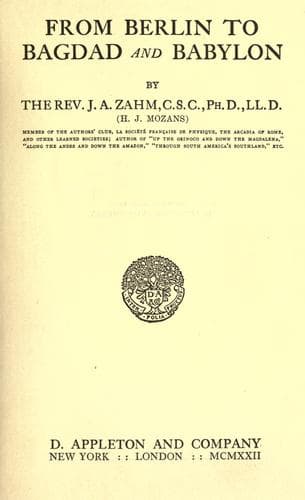
From Berlin to Bagdad and BabylonZahm, J. A. (John Augustine)
HistoryChristian
From Berlin to Bagdad and Babylon
Zahm, J. A. (John Augustine)
Middle East -- Civilization; Middle East -- Description and travel
A brilliant French publicist attributes the success of the Germans in
securing the concession for the Bagdad Railway to the fact that the
era of great ambassadors from France and England at the Sublime Porte
was closed at the period in question--that in the year immediately
preceding “the publication of the irade of the concession in 1899,”
there was then “an utter bankruptcy of great men” at Constantinople
from these two countries.[157]
Opposed to the English, French, and Russian Ambassadors, and almost
isolated from his colleagues, was the alert and sagacious Baron
Marschall von Bieberstein, the noted ambassador from Germany who,
according to an anonymous writer in the _National Review_, “was
the most influential of the ambassadors at Yildiz, and, in accordance
with the thoroughly sensible and practical cast of German ideas as to
the functions of diplomacy, had used his position more actively and
successfully than any minister had done before to promote the business
interest of his nationals in Turkey.”[158]
Not to speak of the failure of France and Russia to secure the
concession for building the Bagdad Railway, it may here be declared
that England’s hopes of securing it were doomed from the very
beginning. Her control of the Suez Canal and her occupation of
Egypt, which was the territory of a Turkish vassal, not to speak of
Gladstone’s denunciation of the Sultan as the “Great Assassin,” all
predisposed Abdul-Hamid in favor of Germany and as strongly predisposed
him against Great Britain.
A writer in the _National Review_, referring to this subject,
declares:
For many years the immobile Turk had never been so likely to
go out of his way for any purpose in the world as when an
opportunity to do the English Government a discourtesy or
English influence a disservice; and it may almost be said that
even a bribe worthy of the fabulous wealth of the detested
island would not have induced Abdul-Hamid to give to an
Englishman what he could give to any one else.[159]
When it was officially announced that the concession for the building
of the Bagdad Railway had been granted to a German syndicate, there
was great jubilation from the Rhine to the Vistula over what was
regarded as a great victory for Teutonic diplomacy and enterprise. The
enthusiastic sons of the Fatherland fancied that they already saw the
well-equipped trains of the Bagdad Railway “running in the track of
Alexander” from the Dardanelles to the embouchure of the Shatt-el-Arab,
and exulted in the thought that “where the Mermnadæ, the Achæmenidæ,
and the Greek, Roman, Arabic, and Turkish conquerors failed, there
Germany had a good prospect of success.”[160]
In Turkey the diplomatic victory of the Germans meant a great
exaltation of Teutonic prestige and a corresponding diminution of the
credit and influence of the defeated Powers.
Public-domain text, read in full here on John Shaqi.
Reviews
Reviews
No reviews yet
Be the first to share your thoughts on this work.
Elsewhere in the archive
Join the Discussion
Join the discussion
Sign in to leave a comment or review.
Sign InorCreate an account