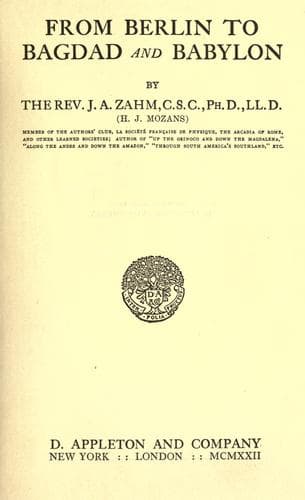
From Berlin to Bagdad and BabylonZahm, J. A. (John Augustine)
HistoryChristian
From Berlin to Bagdad and Babylon
Zahm, J. A. (John Augustine)
Middle East -- Civilization; Middle East -- Description and travel
In the meantime the Teutonic Powers were trying to secure the necessary
capital for their stupendous enterprise. From the very beginning of
their vast undertaking they, under the lead of Dr. Siemens, president
of the Administrative Board of the Anatolian Railway, fully realized
the difficulties they would encounter in securing the funds requisite
to cover the enormous cost of their colossal work. But to achieve
success they had recourse to all the methods of shrewd business and
sane diplomacy. And they were quick to perceive that the wisest and
safest policy would be to work along the line of least resistance.
Instead, therefore, of antagonizing their defeated competitors
they would invite them to coöperate with them in the construction
and operation of the great steel highway. They would, in a word,
internationalize it and make it a purely commercial enterprise, whose
sole object would be the expansion of western trade and the development
of the fabulous resources of the mysterious East.
But, as the concessionaires soon discovered to their surprise and
disappointment, this was more easily said than done. The story of their
many and long negotiations with foreign capitalists and statesmen
is a long one and reveals, as few other things have done, national
jealousies, distrusts, and ambitions. Each of the nations concerned
desired to have the lion’s share in the building and management of the
road, and, when this was impossible, those who had perforce to accept
minor parts, or none at all, strove by every means in their power,
covertly or openly, to misrepresent the object of the undertaking and
damn it in the estimation of those who were counted on to coöperate in
carrying the enterprise to a successful conclusion.
Neither the French nor the English government was willing to give
the Bagdad Railway project official recommendation. This attitude of
the two governments deterred many capitalists from investing in an
enterprise which they had been disposed to view most favorably. The
French Government went so far as to forbid the securities to be listed
on the Bourse.[167]
But the chief opposition to the project came not so much from the
governments in question as from the press. This was particularly the
case in England.
A letter written in 1903 by the late Sir Clinton Dawkins--one of
a group of English capitalists who were eager to coöperate with the
Germans in the building of the Bagdad Railway--to Herr Arthur von
Gwinner, the successor of Dr. von Siemens as director of the road,
leaves no doubt about this whatever.
The fact is [Sir Clinton writes] that the business has become
involved in politics here, and has been sacrificed to the very
violent and bitter feeling against Germany exhibited by the
majority of our newspapers and shared in by a large number of
people.
Public-domain text, read in full here on John Shaqi.
Reviews
Reviews
No reviews yet
Be the first to share your thoughts on this work.
Elsewhere in the archive
Join the Discussion
Join the discussion
Sign in to leave a comment or review.
Sign InorCreate an account