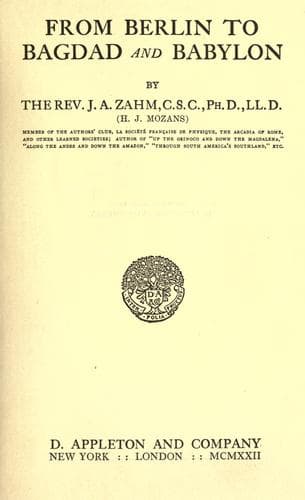
From Berlin to Bagdad and BabylonZahm, J. A. (John Augustine)
HistoryChristian
From Berlin to Bagdad and Babylon
Zahm, J. A. (John Augustine)
Middle East -- Civilization; Middle East -- Description and travel
This is a feeling which, as the history of recent events will
show you, is not shared by the Government or reflected in
official circles. But of its intensity outside those circles,
for the moment, there can be no doubt; at the present moment
coöperation in any enterprise which could be represented, or,
I might more justly say, _mis_represented, as German
will meet with a violent hostility which our government has
to consider.... The anti-German feeling prevailed with the
majority; London having really gone into a frenzy on the matter,
owing to the newspaper campaign which it would have been quite
impossible to counteract or influence.[168]
As a result of an important meeting of Potsdam between the Czar and the
Kaiser in November 1910, Russia waived all share in the Bagdad Railway.
The reason for this withdrawal was, it is asserted, the willingness
of Germany to allow Russia to build a railway in the north of Persia
which should eventually connect with a branch of the Bagdad Railway at
Khanakin on the Persian frontier.
The reason, therefore, why the Bagdad Railway was not
internationalized, as was the desire of Dr. Siemens and his associates,
is manifest. The nations constituting the _Entente Cordiale_ were
unwilling to accept the offer of the _concessionaires_, who thereafter
proceeded to construct the line without outside assistance.[169]
When the statesmen and financiers of France and England found that
internationalization of the Bagdad Railway was impossible and that
the Germans were preparing to build it without their coöperation they
bethought themselves of killing the enterprise by creating a financial
vacuum:
“Let a vacuum of capital be created around the Bagdad Railway,”
ironically writes M. André Geraud, who had no sympathy with the methods
his countrymen and their English allies had adopted in their dealings
with the German _concessionaires_, “let the Anglo-French air-pump
be set in action, and then, as soon as the pecuniary oxygen becomes
rarefied, the Bagdad Railway will be seen to languish and die.”[170]
But this method, it was soon discovered, utterly failed to have the
desired effect. It neither deprived the railway company of resources
nor checked its activity. “The air-pump,” as M. Geraud wittily remarks,
“broke down as soon as it was started.”[171]
The time had passed when it could be truthfully said that the Bagdad
Railway could not be built by a single power. The same statement had
been made regarding the Suez Canal, but France, under the lead of De
Lesseps, showed what the enterprise and the genius of her people were
capable of accomplishing when they were united in an undertaking that
was to reflect on them imperishable glory and redound at the same time
to the welfare of humanity.
Public-domain text, read in full here on John Shaqi.
Reviews
Reviews
No reviews yet
Be the first to share your thoughts on this work.
Elsewhere in the archive
Join the Discussion
Join the discussion
Sign in to leave a comment or review.
Sign InorCreate an account