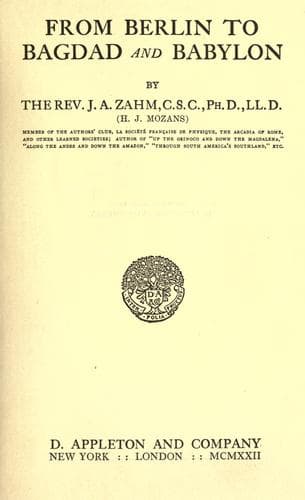
From Berlin to Bagdad and BabylonZahm, J. A. (John Augustine)
HistoryChristian
From Berlin to Bagdad and Babylon
Zahm, J. A. (John Augustine)
Middle East -- Civilization; Middle East -- Description and travel
The plain which we now traversed was for a considerable distance
gravelly land, alternately marshy and dry and not infrequently very
saline. Rocks of a volcanic character were often visible. There
were little evidences of life except here and there long droves of
heavily burdened donkeys and camels and occasional flocks and herds of
wandering Turkomans.
Trains of camels in the deserts of Asia and Africa have always had a
peculiar fascination for me. Like the llama trains of the Peruvian and
Bolivian Andes they seem to be specially adapted to their environment
and to the work which they are called upon to perform. Before the
invention of the steam engine both, in their sphere, were all but
indispensable--the sure-footed llama on dizzy mountain heights, the
thirst-resisting camel in torrid, interminable deserts. Even since the
appearance of the locomotive these useful animals are apparently as
much in demand as ever. For, in addition to transporting merchandise,
as formerly, where railroads do not exist, they are still in constant
use in delivering goods to such roads as are already in operation.
In the region of which I am now speaking, one, at times, sees only
three or four camels at most; at others there are a hundred or more,
all loaded to the limit of endurance. But whenever they appear in the
gray, barren, undulating plain, they, with their drivers, at once
give life and color to the landscape which is else but a dull study
in monochrome. Their leader is usually a dirty, unkempt, diminutive
donkey--in marked contrast to the stately animals that submissively
follow him--which is frequently bestridden by a somnolent Turk wearing
a faded old fez and voluminous red trousers, with his legs reaching
almost to the ground. As the caravan gradually approaches one hears the
jingling of the bells of the light-stepping donkey and the clanging of
the larger bells of the heavy, lurching camel. But we also presently
discover that both donkey and camels are decked with gaudy trappings
adorned with beads and cowrie shells. These, however, are not solely
for ornament, as one might suppose, but rather to avert the evil eye
which, in the Near East, is even more dreaded than it is in any part of
southern Italy.
Public-domain text, read in full here on John Shaqi.
Reviews
Reviews
No reviews yet
Be the first to share your thoughts on this work.
Elsewhere in the archive
Join the Discussion
Join the discussion
Sign in to leave a comment or review.
Sign InorCreate an account