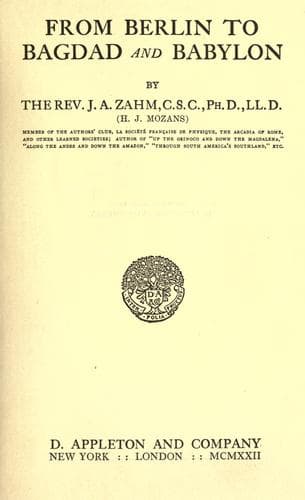
From Berlin to Bagdad and BabylonZahm, J. A. (John Augustine)
HistoryChristian
From Berlin to Bagdad and Babylon
Zahm, J. A. (John Augustine)
Middle East -- Civilization; Middle East -- Description and travel
How the camel carries one back to patriarchal times, to times even when
the domesticated horse was known only in warfare! As a long line of
betasselled camels came near our train one day, they seemed by their
sneers and the lofty manner in which they held up their heads to be
conscious of their ancient lineage and to resent the trespassing by the
Bagdad Railway on what was long their exclusive domain. But to judge by
the general appearance of the country--the old patched tents, the reed
huts, the hovels of unbaked mud, the peculiar garb of the people, the
primitive methods of agriculture, the simple manners and customs of
the people--this part of Anatolia, notwithstanding the advent of the
iron horse, is in almost the same condition as it was when Joseph and
his brethren tended their father’s flocks in the land of Canaan.
If this part of Asia Minor was as arid and desolate in the days of
Godfrey de Bouillon and Barbarossa--and we have no reason to believe it
was materially different--we can easily realize what must have been the
trials and sufferings of the Crusaders during their long march through
“burning Phrygia” and inhospitable Lycaonia. Their route was through a
dry, sterile, and salty desert, a land of tribulation and horror.[192]
It was then, no wonder that, in view of the perils and sufferings
entailed by an inland expedition, the later Crusaders preferred to make
the journey from Europe to the Holy Land by sea.
Terror [writes Michaud] opened to the pilgrims all the passages
of Mount Taurus. Throughout their triumphant march the
Christians had nothing to dread but famine, the heat of the
climate and the badness of the roads. They had particularly much
to suffer in crossing a mountain situated between Coxon and
Marash which their historians denominate, “The Mountain of the
Devil.”[193]
So great, indeed, were the toils and dangers and disasters experienced
by the Crusaders before they reached the Holy City of Jerusalem,
that the brilliant French historian is moved to declare, “If great
national remembrances inspire us with the same enthusiasm, if we
entertain as strong a respect for the memory of our ancestors, the
Conquest of the Holy Land must be for us as glorious and memorable an
epoch as the war of Troy was for the people of Greece.”[194] Again
he avers, “When comparing these two memorable wars and the poetical
masterpieces that have celebrated them, we cannot but think the subject
of the _Jerusalem Delivered_ is more wonderful than that of the
_Iliad_.”[195]
Public-domain text, read in full here on John Shaqi.
Reviews
Reviews
No reviews yet
Be the first to share your thoughts on this work.
Elsewhere in the archive
Join the Discussion
Join the discussion
Sign in to leave a comment or review.
Sign InorCreate an account