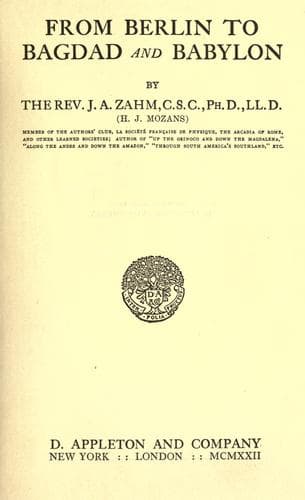
From Berlin to Bagdad and BabylonZahm, J. A. (John Augustine)
HistoryChristian
From Berlin to Bagdad and Babylon
Zahm, J. A. (John Augustine)
Middle East -- Civilization; Middle East -- Description and travel
In Tarsus the future apostle came into close contact with the greatest
teachers and scholars of his time, and was thus prepared to enter the
intellectual arena with the keenest minds of Greece and Rome. Being,
as he could proudly boast, “a Roman of no mean city,” as well as a
disciple of Gamaliel, one of the seven wise men of the Jews, he was
peculiarly fitted to preach the truths of the Gospel not only to his
own people but also to the much greater world of the Gentiles.
Never was a more important or a more far-reaching mission entrusted
to mortal man. It is not too much to say that no one of his time was
better equipped for it than the tent maker of Tarsus. Wherever he
could secure a hearing for his marvelous message he was sure to go--to
the synagogue, to the agora, to the courts of governors and consuls.
Learned in the Law and the Prophets, he was a match for the ablest
teachers of Israel. Familiar with the literature and philosophy of
the pagan world, he spoke as one having authority before the “Men
of Athens” and the representatives of the Cæsars. Thanks to the
opportunities which he enjoyed in his youth of associating with the
wise and learned men of Tarsus and to his thorough acquaintance with
the highest forms of Greek culture, he was able, through his quick
intelligence and his ardent love of souls, “to recognize and sympathize
with the strivings of those who, living in the times of ignorance, were
yet seeking after God, ‘if haply they might feel after Him and find
Him,’ and to read in their aspirations after a higher life the work of
the law written in the hearts of all men.”[210]
As one wanders through the narrow and squalid streets of modern
Tarsus--a city of less than twenty thousand inhabitants--one finds
no vestige whatever of its former splendor. But few ruins remain,
the most conspicuous of which is the concrete foundation of a Roman
structure popularly regarded as the tomb of the cynical voluptuary,
Sardanapalus. No tradition indicates the house of the Apostle of the
Gentiles or points to any church dedicated to his memory. The banks of
the silt-filled Cydnus are lonely and desolate. Owing to the neglected
condition of the river channel, no white-winged ships are here
visible, as of yore, laden with the treasures of foreign lands. And
yet it was up this now abandoned stream that Cleopatra sailed in her
gorgeous barge when she came to answer the challenge of Mark Anthony.
How, by her surpassing address, she led captive the great triumvir is
admirably described by Shakespeare, who, following Plutarch, paints
the famous picture of her entrance into Tarsus, which was then in the
dazzling splendor of oriental magnificence:
Public-domain text, read in full here on John Shaqi.
Reviews
Reviews
No reviews yet
Be the first to share your thoughts on this work.
Elsewhere in the archive
Join the Discussion
Join the discussion
Sign in to leave a comment or review.
Sign InorCreate an account