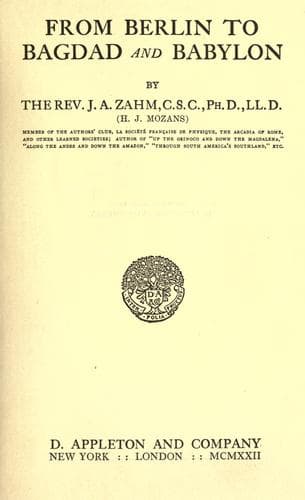
From Berlin to Bagdad and BabylonZahm, J. A. (John Augustine)
HistoryChristian
From Berlin to Bagdad and Babylon
Zahm, J. A. (John Augustine)
Middle East -- Civilization; Middle East -- Description and travel
_The barge she sat in, like a burnisht throne,_
_Burnt on the water; the poop was beaten gold,_
_Purple the sails and so perfumed that_
_The winds were love-sick._
_With them the oars were silver,_
_Which to the tune of flutes kept stroke_
_And made the water which they beat, to follow faster,_
_As amorous of their strokes. For her own person_
_It beggared all description, she did lie_
_In her pavilion, cloth of gold, of tissue,_
_O’erpicturing that Venus, where we see_
_The fancy outwork nature. On each side her_
_Stood pretty dimpled boys, like smiling Cupids,_
_With divers-colored fans whose wind did seem,_
_To glow the delicate cheeks which they did cool,_
_And what they undid did._
The old capital of Cilicia is, of truth, a city of a wonderful historic
past. But among all her proud memories those which have made her best
known throughout the ages and which will endure the longest are not
those of her abounding wealth and luxury, her superb monuments and
palaces and temples, long in ruins; not those that clustered around her
poets and philosophers and made her a favored sanctuary of the Muses;
not those of her schools and gymnasia and her one-time eminence as the
rival of Athens and Alexandria as the home of learning and culture; not
those of Persian satraps and Roman proconsuls who here lived as the
famed representatives of imperial authority; not those awakened by the
presence within her gates of an Asurbanipal, an Alexander, or a Cicero;
not those associated with the love-enmeshed Mark Anthony and the
fateful “Siren of the Nile,” who both perished the ignoble victims of
a debasing passion and a foiled ambition. No; that which has rendered
her immortal is that she was the birthplace of a poor tent maker who
was disowned by his own family because he became the bond servant of
the Crucified, to whom he bore witness from Jerusalem to Rome; of one
who, while preaching the good tidings of the Gospel, toiled night
and day lest he should “be chargeable to any one”; one who, while
preaching the Kingdom of God, was accused by the Thessalonian Jews of
“turning the world upside down”;[211] one who, during his long and
fruitful apostolate and his almost superhuman labors in the service
of his Master, gloried in persecution and was the frequent victim of
stripes and chains and imprisonment; one who was the fearless teacher
and the strong supporter of the infant Church, and whose matchless
Epistles have, during nineteen centuries, been the guide of doctors
and professors; one who wrote his own epitaph when he declared “To me
to live is Christ, and to die is gain,” and who, in the capital of the
Cæsars, won an Apostle’s exceeding great reward--a martyr’s crown; one
whom his contemporaries knew as Saul, otherwise Paul,[212] of Tarsus.
Public-domain text, read in full here on John Shaqi.
Reviews
Reviews
No reviews yet
Be the first to share your thoughts on this work.
Elsewhere in the archive
Join the Discussion
Join the discussion
Sign in to leave a comment or review.
Sign InorCreate an account