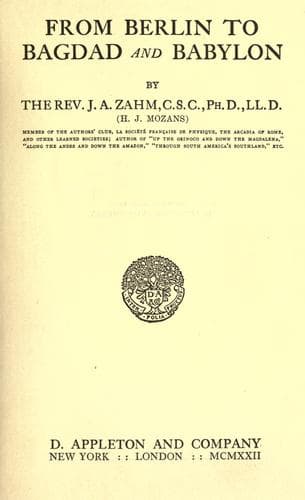
From Berlin to Bagdad and BabylonZahm, J. A. (John Augustine)
HistoryChristian
From Berlin to Bagdad and Babylon
Zahm, J. A. (John Augustine)
Middle East -- Civilization; Middle East -- Description and travel
But the reverence which a Mussulman entertains for his mosque and that
which a Roman Catholic feels for his church are entirely different in
character. There is, in the eyes of a Catholic, a sanctity attaching to
a church that does not and cannot attach to a mosque. This is shown by
the names given to the two places of worship. A common name for mosque
is _Jami_, which means a meeting house, while the word church,
derived from the Greek, signifies the house of God--Τὸ κνριακὸν. In a
Moslem’s view God is present in the _jami_ or mosque, but only as
he is present everywhere else--in the field, on the mountain. But in
the church, according to Catholic teaching, God is really and truly
present under the veil of the Blessed Sacrament. Hence all the pomp and
ceremony of the Catholic ritual, all the gorgeousness of decoration
which so distinguishes the Catholic house of God from the Mussulman
meeting house. Because of the Sacramental Presence every Catholic
church is called the house of God. But among Mohammedans there is
only one specifically recognized _Beith Allah_--house of God.
This is the Kaaba at Mecca, which contains the Black Stone which was
for ages an object of idolatrous worship and which is even to-day the
chiefest object of Mohammedan veneration, if not also of downright
superstition. It is because of the presence of this old pagan fetish in
the Kaaba,[249] as well as on account of the fantastic legends which
are associated with the Kaaba itself, that the Moslem, when praying,
always turns toward Mecca. It is this Kebla--the direction of the Kaaba
in Mecca--that is carefully indicated by the niche or mihrab in the
interior wall of every mosque. For a time the Kebla was changed from
Mecca to the rock in Jerusalem, on which Solomon’s temple was erected,
but, whether from policy or atavism, Mohammed changed it back again
to its original location. By so doing he virtually reduced Islam to a
national religion--the religion of Arabia--instead of making it, as he
had dreamed, the religion of the world.
Again, the mosque, unlike the church, is never the center of that
kind of religious organization which we know as a parish. There is no
congregation comprising those who worship in a particular mosque. Nor
have the imams and khatibs any jurisdiction, like that of a Catholic
pastor, over those who assemble in the mosque for prayer. Worship in
the mosque may be called congregational only in so far as certain
individuals, who happen to gather there, unite in prayer to Allah
under the direction of the imam, but it is nevertheless individual, as
no Moslem has closer affiliations with one mosque than with another.
Wherever he happens to be when the muezzin calls for prayer, there is
his mosque and there he joins with his fellows in worship.
Public-domain text, read in full here on John Shaqi.
Reviews
Reviews
No reviews yet
Be the first to share your thoughts on this work.
Elsewhere in the archive
Join the Discussion
Join the discussion
Sign in to leave a comment or review.
Sign InorCreate an account