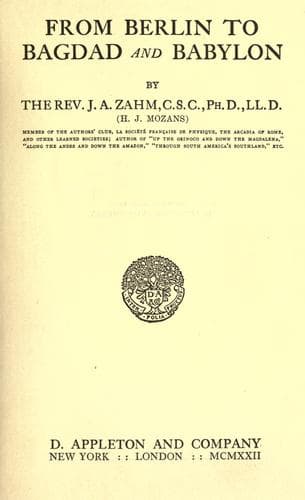
From Berlin to Bagdad and BabylonZahm, J. A. (John Augustine)
HistoryChristian
From Berlin to Bagdad and Babylon
Zahm, J. A. (John Augustine)
Middle East -- Civilization; Middle East -- Description and travel
In the Ottoman Empire the imam, so far as he is charged with special
functions, is no more than a paid servant. Outside of acting as
precentor, or fugleman, at prayer his chief duties are to officiate at
marriages and funerals. There is none of that spiritual relationship
which exists between the Catholic priest and his parishioners; none of
that love of a father for his children, and none of that affection of
children for their father, which exists in every Catholic parish; no
one who is in any sense the shepherd of his flock--to assist the weak,
to direct the erring, to admonish the remiss, to upbraid the sinner,
and lead those aspiring to holiness to higher degrees of perfection
in the spiritual life. Far from feeling the need of such a guide and
superior, the Moslem prides himself on his ability to dispense with
such aids which he would regard as curtailing his religious liberty and
circumscribing his independence of action. He prefers to lead his own
life, without let or hindrance, without monitors or directors, and to
be free, if so disposed, to follow those votaries of pleasure in other
parts of the world, who
_Compound for sins that they’re inclined to_
_By damning those they have no mind to._
But one cannot fully understand the religious spirit of the Mussulman
without knowing something of the prayers which he is wont to address to
the Deity. No class of men, probably, have the name of God--Allah--more
frequently on their lips than the Moslems. This is particularly true of
those devotees--and their number is legion--known as dervishes.
Prayer five times a day is the second of the five pillars of Islam.
At dawn, at midday, in the afternoon, evening and night the Muezzin
ascends the minaret and repeats in a loud voice:
God is great. I bear witness that there is no god but God.
I bear witness that Mohammed is the apostle of God. Come to
prayers! Come to salvation!
But prayer may be said only when the clothes and body of the worshiper
as well as the place of prayer are free from all impurity. Moreover,
the prayers, whether said privately or in common, must be recited
according to a prescribed form and in specified postures from which
there can be no deviation. There are constant repetitions of the words
“God is great,” “I extol the holiness of my Lord, the Most High.”
_Holiness to Thee, O God!_
_And praise be to Thee!_
_Great is Thy name!_
_Great is Thy greatness!_
_There is no deity but Thee!_
Public-domain text, read in full here on John Shaqi.
Reviews
Reviews
No reviews yet
Be the first to share your thoughts on this work.
Elsewhere in the archive
Join the Discussion
Join the discussion
Sign in to leave a comment or review.
Sign InorCreate an account