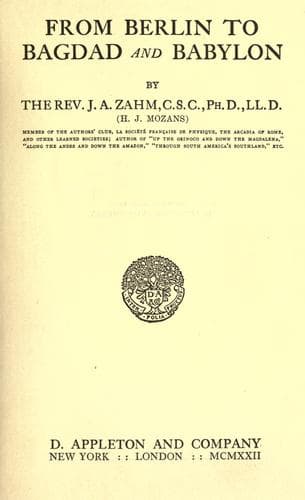
From Berlin to Bagdad and BabylonZahm, J. A. (John Augustine)
HistoryChristian
From Berlin to Bagdad and Babylon
Zahm, J. A. (John Augustine)
Middle East -- Civilization; Middle East -- Description and travel
Now as then the roadways follow the lines of least resistance. But,
owing to the peculiar topographical conditions of many parts of the
Near East, the traveler’s choice of direction is necessarily limited.
In the broad and inhospitable desert his course will necessarily depend
on the location of the few existing springs and wells and wadis, while
in the mountainous regions it will, in great measure, be governed by
a few and widely-separated passes. In many cases, too, where broad
and deep rivers are to be crossed, the direction taken, especially
during the season of rains and floods, will vary with the condition of
often-changing and frequently treacherous fords.
The celebrated Royal Road, of which Herodotus gives so graphic an
account, is a case in point. The student of ancient history is
surprised when he first observes its circuitous course between the
one-time capital of Persia and the famous emporium of Crœsus, but the
reason of it becomes evident when he learns something of the character
of the country through which it passed. He then discovers that the
prehistoric travelers--long centuries before the days of Cyrus and
Darius and Xerxes--who first selected this long and roundabout route
between the plains of Mesopotamia and the shore of the Ægean--a route
which took them over high mountains and pitiless deserts and dangerous
morasses--did simply what a modern railroad engineer would do under
similar circumstances--chose for their venturesome journey the line of
least resistance.[263]
It must, however, here be observed that the word “road,” as used in
the Orient, rarely has the same meaning which we attach to the term.
There a road is rarely anything more than the line of route marked by
the footprints of travelers or beasts of burden. Even the Royal Highway
between Susa and Sardis was nothing more than this. It was only when
the Romans--the great road builders of antiquity--became masters of
western Asia that its leading cities were connected by roads in our
conception of the word. Now, however, only traces of these splendid
highways constructed by the Cæsars exist, and roads available for
wheeled vehicles are still almost as rare in most parts of the Near
East as they were in the time of Tigranes or Tiglath-Pileser.
But, although the great majority of eastern roads have never felt a
spade or pick-ax, and are nothing more than evanescent footprints in
spongy swamp or shifting sand, nevertheless there hangs over most
of them an air of legend and romance and historic association which
stimulates the mind of the traveler in a preëminent degree and affords
as much food for thought as he can find in any of the great highways of
the more civilized regions of the modern world.
Public-domain text, read in full here on John Shaqi.
Reviews
Reviews
No reviews yet
Be the first to share your thoughts on this work.
Elsewhere in the archive
Join the Discussion
Join the discussion
Sign in to leave a comment or review.
Sign InorCreate an account