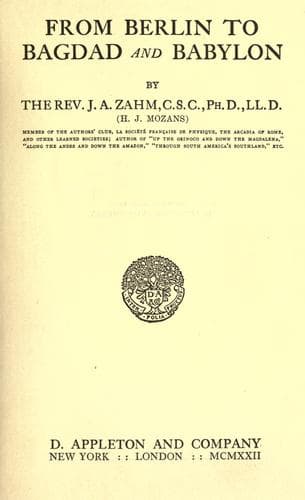
From Berlin to Bagdad and BabylonZahm, J. A. (John Augustine)
HistoryChristian
From Berlin to Bagdad and Babylon
Zahm, J. A. (John Augustine)
Middle East -- Civilization; Middle East -- Description and travel
The foregoing statements are illuminating in the information supplied
respecting the size of the caravans and the amount of merchandise they
transported, but they give us no idea of the great fatigues and dangers
that were incurred in the long journeys through the cheerless deserts
which were inhabited for the most part by hostile and plunder-seeking
Bedouins. The Venetian traveler, Cæsar Frederick, throws some light
on the character of the country which the caravans had to traverse.
Returning in 1581 from his long wanderings of eighteen years in India
and beyond he tells us that:
From Babilon to Aleppo is forty days’ journey, in which they
make thirty-six days over the Wilderness, in which thirty-six
days they neither see houses, trees nor people that inhabit it,
but only a plaine and no signe of any way in the world.... I say
in thirty-six dayes we passe over the wildernesse. For when we
depart from Babilon two dayes wee passe by villages inhabited
until we have passed the river Euphrates. And then within two
dayes of Aleppo we have villages inhabited.[272]
As a precaution against attacks by Arab robbers, Pietro della Valle
informs us that it was always necessary to post at night a strong guard
around the caravan. “During the entire night this guard runs around the
camp shouting--as is their custom--to their friends to be on the alert
and their enemies to keep away.”[273] How conducive to sleep was all
this to the anxious and way-worn members of the caravan!
But
_While beasts and men together o’er the plain_
_Moved on--a mighty caravan of pain_,
they were not entirely cut off from the rest of the world. Although
it was long generations before the invention of the telegraph and
the telephone, they were able to keep up communication with their
friends by means of homing pigeons of which the caravan bashis released
one every other day of the journey through the desert. By means of
these pigeons, which had been used in the East since the days of the
Crusades, the leaders of caravans, Linschoten records, were able to
keep up regular communication not only with Bagdad, Basra, and Aleppo
but also with far distant Constantinople.
Although the great camel trains which were formerly so indispensable
to the merchant of the Levant have long given place to the lines of
steamships that now connect the East and the West by way of the Suez
Canal and the Cape of Good Hope, the Syrian and Arabian deserts still
witness as large caravans as were ever known in the most flourishing
period of overland traffic between Aleppo and Bagdad. Such caravans are
now, however, but little used for the purpose of commerce but rather
for transporting the countless thousands of pious pilgrims who annually
visit the holy cities of Mecca and Medina.
Public-domain text, read in full here on John Shaqi.
Reviews
Reviews
No reviews yet
Be the first to share your thoughts on this work.
Elsewhere in the archive
Join the Discussion
Join the discussion
Sign in to leave a comment or review.
Sign InorCreate an account