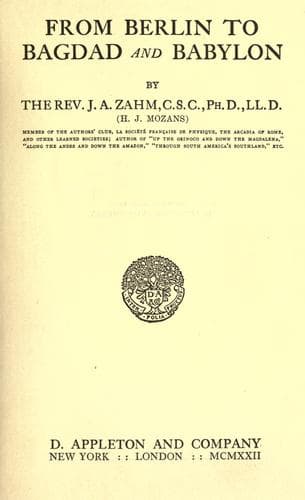
From Berlin to Bagdad and BabylonZahm, J. A. (John Augustine)
HistoryChristian
From Berlin to Bagdad and Babylon
Zahm, J. A. (John Augustine)
Middle East -- Civilization; Middle East -- Description and travel
As I contemplated the sandy wilderness before me, it required a special
effort of the imagination to believe that it was once the home of a
powerful race which has long disappeared. It recalled, rather, scenes
I had witnessed in the arid Sahara or in the barren wastes of northern
Chile and southern Peru. The only traces now left here of their once
mighty empire are the numerous tells which dot the wide expanse of
the desert plain. Beneath the superincumbent earth of these frequent
mounds, are all that remains of the homes of the people who inhabited
these parts in the long, long ago. Some of these tells, which rise up
everywhere in this region like islands in the sea, may some day, under
the well-directed work of the archæologist, yield up long concealed
monuments that will be of priceless value to the historian and add
immensely to our rapidly increasing knowledge of the former inhabitants
of this once famous land. Recent discoveries in so many other parts of
Mesopotamia render such a conjecture eminently probable.
We interrupted our journey between the Euphrates and the Tigris by
making a short side trip to Urfa, formerly the great city of Edessa.
It, like Tarsus, was once a celebrated literary center and for that
reason, if for no other, it had, for at least one of our party, a very
special attraction.
Like all the old cities of the East, Urfa is rich in myths and legends
as well as in historic memories both sacred and profane. According
to a Jewish legend which identified it with the Arach of the Bible,
it was founded by Nimrod, “the mighty hunter before the Lord.”[298]
Another legend attributes the city’s foundation to Enoch, the Hermes
Trismegistes of the Orientals. Equally fabulous was the tradition about
the tent of the patriarch Jacob, which, it was averred, was preserved
in Edessa until it was destroyed by a thunderbolt in the reign of
Emperor Antoninus. But these and similar tales regarding the antiquity
of Edessa are all based on myths and fables, for its history dates only
from the beginning of the little Kingdom of Osrhoene, which was not
founded until 132 B. C.
There is, however, a legend--one of the most beautiful of the early
Christian Church--which is connected with Edessa and which deserves
more than a passing notice. It was supposed for a long time to explain
why Edessa became, at an early date, not only the first Christian city
of Mesopotamia but also its greatest religious center, and to account
for its preponderating influence in the spread of the Gospel throughout
the Orient. Humanly speaking, such good fortune could not have befallen
so humble a community as that of Osrhoene, which was at first composed
of but a small number of Christians, and which, in the natural course
of events, would have made but slow progress in a pagan or Jewish
environment which, if not openly hostile, was decidedly indifferent.
Public-domain text, read in full here on John Shaqi.
Reviews
Reviews
No reviews yet
Be the first to share your thoughts on this work.
Elsewhere in the archive
Join the Discussion
Join the discussion
Sign in to leave a comment or review.
Sign InorCreate an account