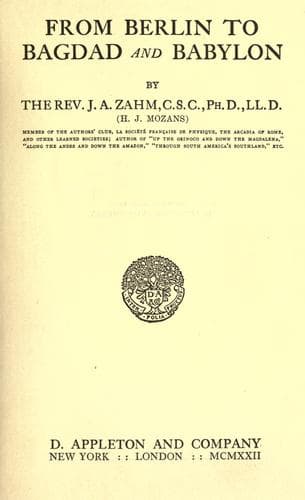
From Berlin to Bagdad and BabylonZahm, J. A. (John Augustine)
HistoryChristian
From Berlin to Bagdad and Babylon
Zahm, J. A. (John Augustine)
Middle East -- Civilization; Middle East -- Description and travel
Those who may still cling to Nestorianism--if there yet be any--have
long practically forgotten the great questions that so distracted
the Church in the East in the days of Nestorius, Diodore of Tarsus,
and Theodore of Mopsuestia. Few of them know why they have ever been
separated from the Church of Rome, and, when questioned about it,
are able to give no better reason than “Because we have always been
separated.” With the exception of the heresy of Nestorius which was
condemned at Ephesus, the faith of the Nestorians is virtually the same
as that taught by the Church of Rome. Like other Eastern Churches,
the Nestorian has its peculiar liturgy, rites, laws, customs, but
these are so far from affecting the truths of faith, that converts
from Nestorianism are allowed by Rome to retain all its peculiarities
of worship and religious observance, except in the rare cases in
which they actually conflict with Catholic dogma. This is evidenced
in the rites and liturgy of the Chaldeans--the Uniates, or converted
Nestorians--which are exactly the same as the schismatic Nestorians
have used from time immemorial.
When in 1750 the Dominican missionaries took up their abode in Mosul,
they found there but one Catholic family and that was one of the
Chaldean rite. But so fruitful was their work of conversion that the
Patriarch of Mesopotamia and Lower Kurdistan soon afterwards resigned
his position and his nephew and successor Mar Yohannan applied for
admission into the Church of Rome. He was followed almost immediately
by five of his bishops and by the greater part of his people in and
around Mosul.
This rapid movement Romeward of the Nestorian pastors and their flocks
is partly explained by the fact that they saw no valid reason for
remaining separated from a Church which taught the same doctrines as
they themselves had always believed and which, during long centuries of
persecution, they had preserved intact. But their reunion with Rome was
hastened by the tact and zeal of the learned and sympathetic Dominicans
whom all soon learned to revere and love. For these devoted priests not
only aided these poor but earnest people in becoming reconciled with
the Mother Church on the most lenient terms, but they also established
for them schools and asylums and hospitals where both souls and bodies
could receive much needed care.
Public-domain text, read in full here on John Shaqi.
Reviews
Reviews
No reviews yet
Be the first to share your thoughts on this work.
Elsewhere in the archive
Join the Discussion
Join the discussion
Sign in to leave a comment or review.
Sign InorCreate an account