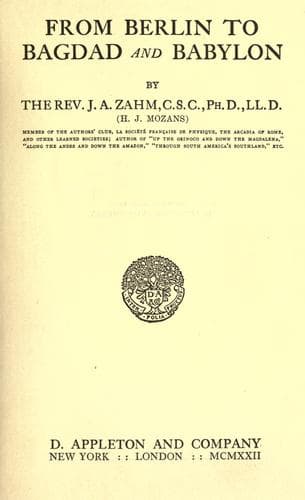
From Berlin to Bagdad and BabylonZahm, J. A. (John Augustine)
HistoryChristian
From Berlin to Bagdad and Babylon
Zahm, J. A. (John Augustine)
Middle East -- Civilization; Middle East -- Description and travel
In Mosul an up-to-date printing establishment was installed in which
were printed the Scriptures and other books in Arabic, Syriac, and
other languages. A seminary was founded for the benefit of Chaldean
students destined for the priesthood. The education of girls was
entrusted to the highly cultured Dominican Sisters of the Presentation
of Tours, France. Not only did they assume charge of preparatory and
normal schools but they also opened industrial schools for girls,
especially for the working girls of the city. They also took charge of
dispensaries where thousands of poor and sick people received free of
charge the medicine and treatment which their condition required and
which, before the arrival of these ministering angels of mercy, were
not available.
In view of all these facts is there anything surprising in the final
return of the followers of Nestorius to communion with Rome?[324]
The history of the Jacobites, of whom Marco Polo found many in
Mosul--“Christians indeed, but not in the fashion enjoined by the
Pope of Rome”--differs but little, except in one point of doctrine,
from that of the Nestorians. This point of doctrine is in one respect
the very opposite of the distinguishing dogma of the Nestorians. For,
whereas the Nestorians divided Christ into two persons against the
Catholic doctrine which maintained His unity, the Jacobites, contrary
to Catholic teaching, asserted that there is in Christ but one nature
and not two, the human and the divine, as decreed in 451, by the
Œcumenical Council of Chalcedon.[325] It is because this heresy teaches
the fusion of Our Lord’s humanity and divinity that it is called
Monophysitism. And because, in its early stages, it was so ardently
championed by Eutyches, an archimandrite of a monastery outside the
walls of Constantinople, it is also known as Eutychianism. The Syrian
Monophysites are usually called Jacobites, after Jacob Zanzalos, who
was an early and zealous propagator of the heresy.
So far as statistics are available the number of Jacobites is somewhat
larger than was that of the Nestorians when the Dominicans began to
lead them back to obedience to Rome. They are scattered throughout
Syria and Mesopotamia and Malabar. Their Patriarch, who always takes
the name Ignatius with the title of Antioch, resides at Mardin or
Diarbekir on the Upper Tigris to the northwest of Mosul. Although they
all talk Arabic, the Jacobites use the Syrian liturgy of St. James.
In consequence of the missionary labors of the Franciscans, Dominicans,
and Capuchins the majority of the Jacobites are again in communion with
Rome under the name of Melchites or Syrian Uniates. Their Patriarch
with the title of Antioch usually resides at Beirut. He has eight
suffragans, most of whom live in Mesopotamia. From present indications
the day does not seem distant when the Jacobites, like the Nestorians,
shall once more be reunited with the See of Peter, from which they have
so long been separated.
Public-domain text, read in full here on John Shaqi.
Reviews
Reviews
No reviews yet
Be the first to share your thoughts on this work.
Elsewhere in the archive
Join the Discussion
Join the discussion
Sign in to leave a comment or review.
Sign InorCreate an account