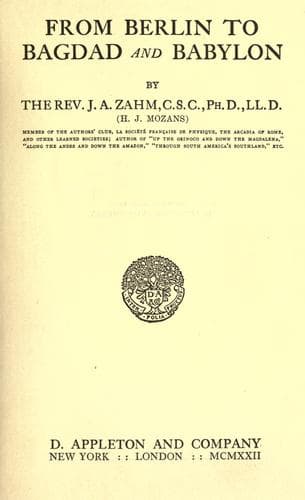
From Berlin to Bagdad and BabylonZahm, J. A. (John Augustine)
HistoryChristian
From Berlin to Bagdad and Babylon
Zahm, J. A. (John Augustine)
Middle East -- Civilization; Middle East -- Description and travel
The Nestorian and Monophysite Churches, as we have noted, originated
in certain specific heresies of Nestorius and Eutyches. But the false
doctrines of these heresiarchs, as has been observed, contributed less
towards the separation of the Copts, Syrians, and others than did the
intense nationalism of these peoples who wanted only a pretext under
the guise of heresy for concealing their disloyalty to the Byzantine
Empire. Few of the rank and file knew anything about the theological
issues involved in the false doctrines of their leaders. The majority
of them were almost as ignorant of their real bearing on Catholic dogma
when the Councils of Ephesus and Chalcedon issued their famous decrees
as they are to-day. With possibly a few exceptions not even the clergy
or the bishops of the Eastern Churches are now aware of what was the
cardinal issue of their schism or are able to give anything more than
the vaguest and most shadowy reason for their continued separation from
the Church of Rome.
The Orthodox Churches--which embrace those Christians who use
the Byzantine rite but are not in communion with the Catholic
Church--unlike the Eastern Churches of which we have spoken, had
their origin not in heresy but in schism, pure and simple. Many
and various were the causes of this schism but the chief of them
were the jealousies and ambitions of the Emperors and Patriarchs of
Constantinople. And these jealousies and ambitions began at an early
date and gradually developed until they eventually culminated in the
fatal schism precipitated by Photius and Cerularius. For
_After that Constantine the Eagle turned_
_Against the course of heaven which it had followed_,[333]
there was ever-increasing friction between the East and the West.
Constantine, fully occupied with the affairs of his vast empire,
had wisely allowed the Church to govern herself[334] but such,
unfortunately, was not the policy of his successors. Continually
interfering in ecclesiastical affairs and determining questions of
doctrine by imperial decrees, they soon proved themselves the worst
enemies of the Church’s freedom of action. This was particularly true
during the Byzantine period which extended from the accession of
Justinian to the throne to the fall of Constantinople under Mohammed
II. During all this time the Emperors were unremitting in their
efforts to make the Church a subject of the State. In this they had
the ever-ready cooperation of the court bishops, whose subservience is
easily explained. Their ambitions were great and they counted on their
imperial masters to help them to realize their unholy aspirations. Nor
were they disappointed.
Public-domain text, read in full here on John Shaqi.
Reviews
Reviews
No reviews yet
Be the first to share your thoughts on this work.
Elsewhere in the archive
Join the Discussion
Join the discussion
Sign in to leave a comment or review.
Sign InorCreate an account