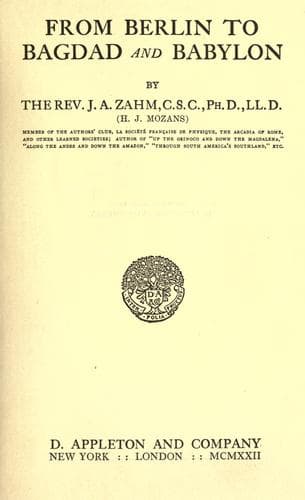
From Berlin to Bagdad and BabylonZahm, J. A. (John Augustine)
HistoryChristian
From Berlin to Bagdad and Babylon
Zahm, J. A. (John Augustine)
Middle East -- Civilization; Middle East -- Description and travel
But since the outbreak of the schism, a new barrier had been erected
between the East and the West, which seemed almost insurmountable.
This was the result of the horrible sack of Constantinople by the
soldiers of the Fourth Crusade. The cruelties, massacres, and
wholesale destruction of the choicest works of art which attended this
unpardonable outrage made it one of the most shocking events in the
history of the capital.[340] Then, too, there was the establishment of
the Latin Empire in Constantinople and the erection of Frankish States
in Syria and Palestine. This ruthless ignoring by the Latins of the
sovereign rights of a Christian power and all the wanton cruelty that
accompanied it was still fresh in the minds of the Greek delegates when
they convened at Lyons and Florence and this, added to all the causes
of friction that had so long rankled in the hearts of the Byzantines,
made a successful issue of the deliberations of the assembled fathers
almost hopeless.
Notwithstanding, however, all the causes of rancor that existed, a
reunion was effected by each of the Councils but in each case it lasted
only a very short time. For no sooner did the people of Constantinople
hear of the action of the Council of Lyons than, exercising what should
now be called the right of referendum, they rose in insurrection
against it. As a result, however, of the reunion brought about by the
Council of Florence, the Byzantine Church remained, at least nominally,
in communion with the Holy See for a period of thirty-three years--from
1439 to 1472. It was during this fateful time that Constantinople was
taken by the Turks under Mohammed II.
The Conquest of Constantinople was almost as great a turning point
in the history of the Byzantine Church as was the Great Schism of
Photius and Cerularius. For the Sultan had scarcely taken possession
of the city when he sent for the leader of the anti-Papal party, one
George Scholarios, and, with a view of winning him together with the
schismatic Byzantines over to his rule as against that of the Catholic
Powers of the West, he had him made Patriarch, although at the time of
his appointment Scholarios seems to have been a layman.
No sooner had the Sultan championed the cause of the Greeks against
Rome than they at once exultingly rallied around their Patriarch and,
in words of deepest hatred and wildest fanaticism, shouted: “Rather the
Sultan’s turban than the Pope’s tiara.” They have had their choice but
with what long centuries of degradation and ignominy!
Public-domain text, read in full here on John Shaqi.
Reviews
Reviews
No reviews yet
Be the first to share your thoughts on this work.
Elsewhere in the archive
Join the Discussion
Join the discussion
Sign in to leave a comment or review.
Sign InorCreate an account