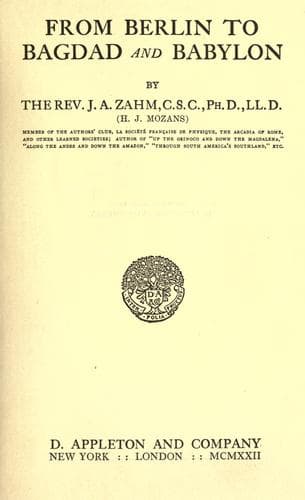
From Berlin to Bagdad and BabylonZahm, J. A. (John Augustine)
HistoryChristian
From Berlin to Bagdad and Babylon
Zahm, J. A. (John Augustine)
Middle East -- Civilization; Middle East -- Description and travel
Neither the Patriarch nor his followers had to wait long before
the scales fell from their eyes. For no sooner had Scholarios,
under the direction of the Sultan, been appointed to the See of
Constantinople than Mohammed sent for him and handed him the
_berat_-diploma[341]--which defined what were his duties and
prerogatives as Patriarch under the Moslem Government. But this was not
all. For scarcely had he been invested with the signs of his spiritual
jurisdiction than the unfortunate Patriarch was given to understand
that he was nothing more than a puppet in the hands of his Moslem
master who could depose him at will. Each of his successors since that
time in the See of Constantinople has been obliged to submit to the
same humiliating ceremony of investiture.
To their intense chagrin the Patriarchs soon learned furthermore that
their appointment had to be followed by a gift to the Sultan of a large
sum of money; that their tenure of office would rarely exceed two
years;[342] that they could be deposed to make room for others who were
forced to pay similar exorbitant sums for their appointment; that they
might be deposed and reappointed no fewer than five times and at each
appointment to the office from which they had been deposed, they would
be obliged to renew the enormous bribe to their arbitrary and rapacious
overlord.
The result was simony of the worst kind, for, in order to obtain
the money required by the Moslem tyrant for their appointment, the
subservient Patriarchs resorted to the selling of benefices to priests
and bishops and metropolitans. To such an extent had this sacrilegious
traffic in the things of God been carried on that simony has long
made the Orthodox Church “a reproach and a scoff, an example and an
astonishment among the nations that are round about her.”
But the troubles and humiliations of the Œcumenical Patriarch--as
the Primate of the Byzantine Church is called--did not end with his
degrading investiture by the Sultan, or, as was more frequently the
case, by his Grand Vizier and by the payment of an enormous bribe for
his appointment. Owing to his subjugation to the Sublime Porte, he
soon found himself confronted with untold difficulties based on racial
jealousies and antagonisms. These were augmented by the subserviency of
the Phanar--the Vatican of the Orthodox Church--and the readiness which
Phanariote Greeks always exhibited to become the agents of Turkish
oppression of their fellow Christians--especially those in the Balkans.
It was because the policy of the Phanar was identical with that of the
Porte that the enemies of the Sultan were unwilling to acknowledge any
kind of dependence on the Byzantine Patriarch. This was strikingly
evinced in the war of Greek Independence, as one of the first acts
of the Greek Parliament was to declare the Church in Greece to be
autocephalous.
Public-domain text, read in full here on John Shaqi.
Reviews
Reviews
No reviews yet
Be the first to share your thoughts on this work.
Elsewhere in the archive
Join the Discussion
Join the discussion
Sign in to leave a comment or review.
Sign InorCreate an account