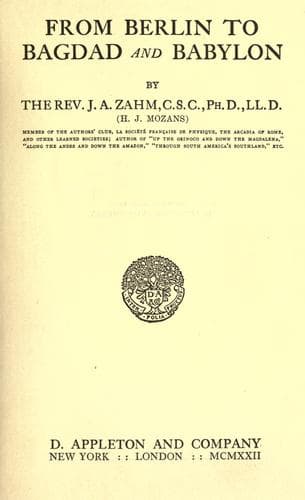
From Berlin to Bagdad and BabylonZahm, J. A. (John Augustine)
HistoryChristian
From Berlin to Bagdad and Babylon
Zahm, J. A. (John Augustine)
Middle East -- Civilization; Middle East -- Description and travel
But, although Assyria’s capital was so thoroughly demolished, its name
and fame still persisted. In the course of time a new Nineveh arose on
the site of the ancient metropolis and, although quite unimportant as
compared with its famous predecessor, it served at a later date to aid
in the identification of the ancient site and to pave the way to some
of the most extraordinary archæological discoveries of the last century.
The great Assyrian Empire came to an end after enduring more than a
thousand years, and being, a great part of this period, one of the
greatest powers of western Asia. Its downfall, after its long centuries
of glory and preëminence, occurred while Rome was yet in its infancy
and little more than a rendezvous of robbers and refugees from justice.
From that date, 707 B. C., nearly twenty-five centuries passed over the
grass and shrub-covered mounds on the site of ancient Nineveh before
any serious effort was made to determine whether they concealed any
remains of the long-buried metropolis of Mesopotamia.
Until the middle of the last century our knowledge of the history of
Assyria and Babylonia was based entirely on the historical books of
the Old Testament and on the accounts given by certain Greek and Latin
writers. The books of Scripture which are of special importance in
their relation to Assyrian and Babylonian history are Isaiah, Jeremiah,
Ezekiel, Nahum, and the Fourth Book of Kings.
Chief among the classical writers is Herodotus. He was not only, as
Cicero calls him, the “Father of History,” but he was also the greatest
traveler of his time. Not only did he traverse a great part of Asia
Minor, Syria, and Egypt, but there is a strong probability that he
extended his peregrinations to the Euphrates and proceeded on its
waters to Babylon. Making all due allowance for numerous inaccuracies
which exist in his picturesque work and for not a few travelers’
tales,[359] the history of the brilliant Greek writer will always
possess value not only for its matchless style but also for the facts
which it contains and its descriptions, which are evidently from the
pen of an eye witness. I refer especially to that part of his charming
work which treats of Babylon and the culture of its inhabitants.
Of more importance was the great history of Babylonia written by
Berosus, a contemporary of Alexander the Great and a priest of Bel in
Babylon. Unfortunately we have only the fragments of this work which
have been preserved by Eusebius, Josephus, and other ancient writers.
But the works mentioned, as well as those of Ctesias, Dinon of
Colophon, and others, threw but little light on the civilization and
achievements of Assyria and Babylonia during their long and eventful
history. Detailed information respecting the development and decline
of these two mighty empires was to come only from native annals of
which not even the existence was suspected until the latter half of the
nineteenth century.
Public-domain text, read in full here on John Shaqi.
Reviews
Reviews
No reviews yet
Be the first to share your thoughts on this work.
Elsewhere in the archive
Join the Discussion
Join the discussion
Sign in to leave a comment or review.
Sign InorCreate an account