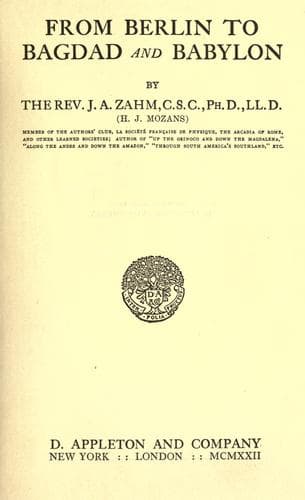
From Berlin to Bagdad and BabylonZahm, J. A. (John Augustine)
HistoryChristian
From Berlin to Bagdad and Babylon
Zahm, J. A. (John Augustine)
Middle East -- Civilization; Middle East -- Description and travel
Nor was there before the beginning of the last century any certitude
regarding the sites of the great Assyrian and Babylonian cities which
had made such a profound impression upon the peoples of the ancient
world. Although history and tradition still spoke of the grandiose
palaces and temples of Nineveh and of the towers and hanging gardens
of Babylon, the general ignorance which almost from the time of the
Arab conquest had prevailed regarding the actual sites of Babylon and
Nineveh was not removed until the illustrious Danish scholar, Carsten
Niebuhr, proved that the site of Babylon was in the vicinity of the
modern village of Hillah, and the noted English investigator, Claudius
James Rich, demonstrated in 1821 that the mounds on the left bank of
the Tigris, just opposite Mosul, covered all that remained of the famed
city of Nineveh.[360]
But even after the sites of Nineveh and Babylon had been identified, it
was yet to be proved that amid the ruins of these famous cities there
were records and monuments which would shed light on the civilization
of which they were once such noted centers. The potsherds and fragments
of cylinders which travelers had found in and about the mounds of
Babylon and Nineveh led scholars to believe that discoveries of greater
value awaited the explorer. This conclusion was confirmed by the
finding in various places of bricks, tablets, and monuments covered
with strange inscriptions which were written in characters which are
now designated as cuneiform.
It was not, however, until 1842 when the French Government--to
which the world of science has long been indebted for intelligent
encouragement and generous assistance in every branch of research--sent
Paul Emil Botta to Mosul that decisive results were obtained. He was
ostensibly appointed to fill there the newly-created position of
vice-consul, but, as French commerce did not require the service of
such an official at that point, he was really designated to act as
the head of an archæological mission to Nineveh and its environs. His
appointment, as subsequent events proved, was a red-letter day in the
annals of Assyrian research. For, not long after his arrival in Mosul,
the world was thrilled by the news of his marvelous discoveries in the
long-buried city of Nineveh and the report that he was “sending home
the spoils of superb ancient edifices to increase the treasures of the
Louvre.... A city buried for more than twenty centuries offered its
remains for comparison with the aspects of modern London and Paris; and
the sculptured monuments of a bygone race rose up to offer a contrast
with the works of modern art.”[361]
Public-domain text, read in full here on John Shaqi.
Reviews
Reviews
No reviews yet
Be the first to share your thoughts on this work.
Elsewhere in the archive
Join the Discussion
Join the discussion
Sign in to leave a comment or review.
Sign InorCreate an account