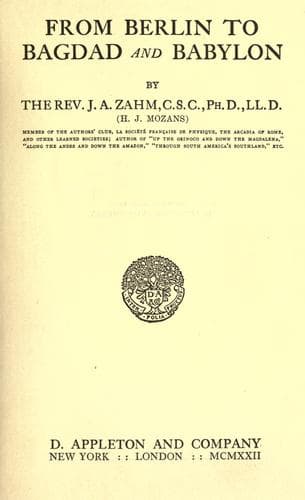
From Berlin to Bagdad and BabylonZahm, J. A. (John Augustine)
HistoryChristian
From Berlin to Bagdad and Babylon
Zahm, J. A. (John Augustine)
Middle East -- Civilization; Middle East -- Description and travel
But it was in his gorgeous palace at Nineveh that he had the joy of
his life--that which was to perpetuate his name to the end of time.
This was his library--the largest and most valuable collection of
documents that the world had yet seen. Composed of myriads of inscribed
tablets, they were fortunately made of a material--baked and unbaked
clay--which, for more than two millennia, successfully withstood all
the ravages of war and the elements. They treated of mathematics,
astronomy, history, poetry, grammar, lexicography, law, religion--in a
word, of the entire circle of the sciences of the ancient world.
Asurbanipal--an Assyrian Mæcenas--was not only the patron of scholars,
whom he encouraged to produce new books on every branch of science and
literature, but was also, as a collector, the worthy forerunner and
rival of the bibliophilous rulers of Pergamum and Alexandria. He had
his scribes visit all the libraries of Babylonia--the earliest home of
science and letters--and had them make copies of all works of value
which did not exist in his own library. So indefatigable, indeed,
was the King as a collector that it is probably true--as has been
stated--that he had in his extensive library a copy of all the books
that existed in the numerous libraries of Assyria and Babylonia.
The discovery of Asurbanipal’s library surpassed in importance any
that had ever been made in either the valley of the Tigris or of the
Euphrates. But every tablet in this immense collection was absolutely
a sealed book, for there was not anyone living then who was able to
decipher a single sentence of those mysterious documents which had
thus so unexpectedly been brought to day. When Layard, in the course
of his exploration of the vast palace of Asurbanipal, first beheld the
priceless contents of the royal halls of records, his emotions must
have been like those of Shelley’s Alastor in the temples of Egypt, for
_Among the ruined temples there,_
_Stupendous columns and wild images_
_Of more than man, where marble demons watch_
_The zodiac’s brazen mystery, and dead men_
_Have their mute thoughts on the mute walls around._
_He lingered, pouring on memorials_
_Of the world’s youth; nor when the moon_
_Filled the mysterious halls with floating shades_
_Suspended he that task, but ever gazed_
_And gazed_
on precious monuments before him which he knew full well contained
_The thrilling secrets of the birth of time_.[365]
Public-domain text, read in full here on John Shaqi.
Reviews
Reviews
No reviews yet
Be the first to share your thoughts on this work.
Elsewhere in the archive
Join the Discussion
Join the discussion
Sign in to leave a comment or review.
Sign InorCreate an account