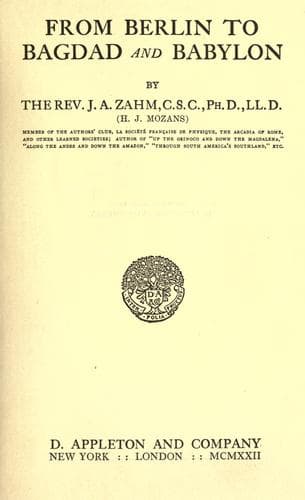
From Berlin to Bagdad and BabylonZahm, J. A. (John Augustine)
HistoryChristian
From Berlin to Bagdad and Babylon
Zahm, J. A. (John Augustine)
Middle East -- Civilization; Middle East -- Description and travel
But as the work of excavation is still almost in its infancy, so
is also that of decipherment and coördination of the myriads of
inscriptions now in the museums of the world. For, notwithstanding the
wonderful achievements of Assyriologists during the last three-quarters
of a century, many generations must yet elapse before the vast amount
of material which has been already collected and to which additions
are being constantly made, can be properly interpreted and made
available for students who are not professional Orientalists. As
yet there is in Assyrian neither a complete grammar nor a complete
dictionary, and, on account of the immense number of ideograms yet
undeciphered and the astonishing number of polyphonous signs in the
Assyrian language--signs which have each several distinct syllabic
values--it is certain that many decades will elapse before the
countless difficulties can be overcome.
Considering, however, the complexity of the problem which confronted
Orientalists at the beginnings of their researches, it is, indeed, a
wonder that their achievements during the last two generations have
been so fruitful and of so far-reaching importance. For in a few
decades they have changed completely our conception of the ancient
peoples of Assyria and Babylonia and shown that their civilization
“stands before us in all its ramifications as one of the great forces
in the ancient history of mankind, the direct or indirect influence
of which is to be seen in many a phase of our modern culture.”[376]
They have proved that the Assyrian language was not only the speech
of the inhabitants of Mesopotamia but that it was also long used as
the language of diplomacy by the Hittites and the Egyptians and by
the peoples of Syria and Palestine. More than this, it was a kind of
_lingua franca_ from the Euxine to the valley of the Nile and from
Cyprus to the plateau of Susiana. This fact is most strikingly proved
by the priceless collections of cuneiform inscriptions which, only a
few years ago, were found in Tel-el-Armana, Egypt, and in Boghaz-Keui,
Asia Minor. These finds are indications that there are other, probably
many other, similar discoveries to reward the patient and well-directed
excavations of the explorer in the ruin-spread lands of the Near East.
Public-domain text, read in full here on John Shaqi.
Reviews
Reviews
No reviews yet
Be the first to share your thoughts on this work.
Elsewhere in the archive
Join the Discussion
Join the discussion
Sign in to leave a comment or review.
Sign InorCreate an account