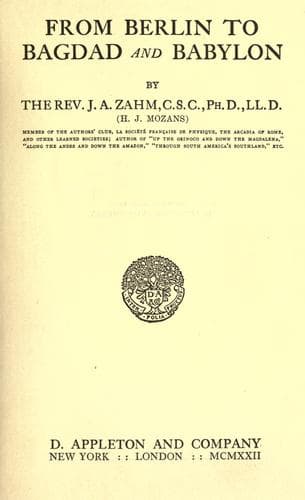
From Berlin to Bagdad and BabylonZahm, J. A. (John Augustine)
HistoryChristian
From Berlin to Bagdad and Babylon
Zahm, J. A. (John Augustine)
Middle East -- Civilization; Middle East -- Description and travel
How often, while wandering among the ruins of Kuyunjik, Nebi Yunus,
and Khorsabad, have I not had brought home to me the far-reaching
changes in our knowledge of the Near East, which have been effected by
the startling discoveries that were made three-quarters of a century
ago in the palaces of Sargon and Sennacherib and Asurbanipal! But
nothing impressed me more than the first question which Scriptural
students always make regarding these discoveries, “How do they bear
on the Bible”? It is the same question which has so often been asked
about the revelations of geology in their bearings on the Sacred
Text. Something is discovered which at the first blush is regarded
as militating against the accuracy of the Sacred Scriptures. After
further investigation, this same discovery is viewed as being strongly
confirmatory of the Bible, while still more careful examination shows
that the teachings of the new science not only do not but, by their
very nature, cannot question, much less impeach the veracity of the
Book of Books.
It is true that one’s view of the Bible may be enlarged with one’s
advancing years; that one’s understanding of it may be improved by more
profound study, and by the progress of research; but science, whether
it appear in the guise of geology, or Assyriology, or of what has
falsely been called the science of evolution, can never invalidate a
single one of the fundamental teachings either of Scripture or of the
Church of Christ.
This thought was borne in upon me with unwonted force as I stood one
day above the ruins of Asurbanipal’s library. Gazing at a cluster of
keleks--skin rafts--bearing their light traffic down the historic
Tigris, as they did when Assyria ruled the East, and recalling the
pictures I had formed of “Nineveh the great city” when as a boy I read
my first history of the Bible--a book that was to exert so paramount an
influence on the studies and thoughts of my after life--I asked myself,
“In what respect does my faith to-day differ from that which I held
three score years ago”? I had then, as Pasteur once said of himself
when at the zenith of his fame and mental vigor, the faith of a Breton
peasant.[377] Since that far-off time when I delighted to picture
the glories of Nineveh and Babylon and dwell on the famous campaigns
and victories, the superb palaces and entertainments of Sennacherib
and Assuerus and Nebuchadnezzar, I have striven to keep abreast with
the intellectual movement of my time and, in so doing, I have never
found anything in any of the new sciences that could by any legitimate
interpretation be construed as being at variance with the teachings of
the religion of my boyhood. We now know incomparably more about the
history, the social and economic condition of the ancient Assyrians
and Babylonians than we did before the explorer brought to light the
literary treasures of Nippur, Telloh, Abu-Habba, and Nineveh; but we
have discovered nothing which is competent to discredit any of the
Public-domain text, read in full here on John Shaqi.
Reviews
Reviews
No reviews yet
Be the first to share your thoughts on this work.
Elsewhere in the archive
Join the Discussion
Join the discussion
Sign in to leave a comment or review.
Sign InorCreate an account