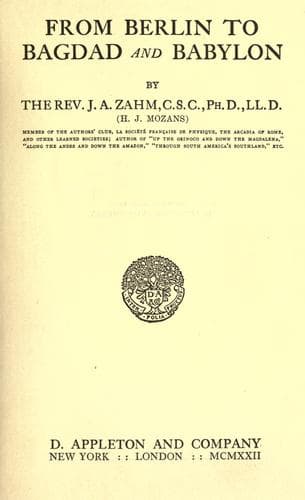
From Berlin to Bagdad and BabylonZahm, J. A. (John Augustine)
HistoryChristian
From Berlin to Bagdad and Babylon
Zahm, J. A. (John Augustine)
Middle East -- Civilization; Middle East -- Description and travel
Never once, during our journey from Mosul to Tekrit were we ever out
of sight of some place or monument of historic or legendary lore. But
the number of these reminders of the hoary past rapidly increased in
our sail between Tekrit and Bagdad. About five miles below Saladin’s
birthplace we came to the little town of Iman Dura. According to
tradition, it was here that King Nebuchadnezzar set up his colossal
golden statue which the Hebrews, Sidrach, Misach, and Abednago, in
defiance of the King’s orders, refused to adore.[413] It was near
Dura that the Roman army under Jovian pitched their tents after the
death of Julian the Apostate and it was here that the Roman Emperor
was forced to conclude an ignominious peace--_necessariam quidem
sed ignobilem_, writes Eutropius--with the Persian King, Sapor the
Great. A short distance below Dura is a small stream which the natives
say was a canal dug by King Solomon. Near it, on the left bank of the
Tigris, begins the ruins of Eski Bagdad--Old Bagdad--“a mighty field of
ruins,” writes Thielmann, “extending some twenty-five miles along the
Tigris.”[414] Situated in this long field of ruins is the little town
of Samara, as celebrated for its romantic history as for its remarkable
monuments which, however, have only in the last decade or two received
the attention on the part of scholars which they so richly deserve.
The ruins of which I have here given a brief account [writes a
well-known archæologist, after a visit to Samara] are of the
first importance for the elucidation of the early history of
the arts of Islam. They can all be dated within a period of
forty years falling in the ninth century, and are, therefore,
among the earliest existing examples of Mohammedan architecture.
They bear witness to the Mesopotamian influences under which
it arose. The spiral towers of Samara and Abu Dulaf are an
adaptation of the temple pyramids and Assyria and Babylonia,
which had a spiral path leading to the summit; the technique of
arch and vault was invented by the ancient East and transmitted
through Sassannian builders to the Arab invaders; the decoration
is Persian or Mesopotamian and almost untouched by the genius
of the West. In the palaces and the mosques of Samara we can
see the conquerors themselves conquered by a culture which
had been developing during thousands of years on Mesopotamian
soil, a culture which had received indeed new elements into
its composition, which had learnt from the Greek and from the
Persian, but had maintained in spite of all modifications its
distinctive character.[415]
Public-domain text, read in full here on John Shaqi.
Reviews
Reviews
No reviews yet
Be the first to share your thoughts on this work.
Elsewhere in the archive
Join the Discussion
Join the discussion
Sign in to leave a comment or review.
Sign InorCreate an account