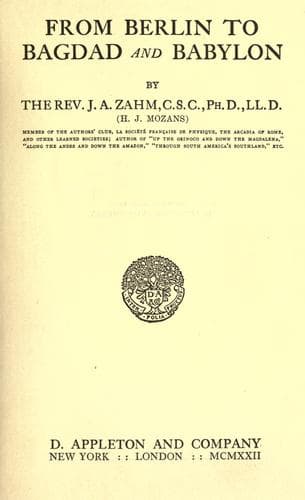
From Berlin to Bagdad and BabylonZahm, J. A. (John Augustine)
HistoryChristian
From Berlin to Bagdad and Babylon
Zahm, J. A. (John Augustine)
Middle East -- Civilization; Middle East -- Description and travel
The complex of ruined mosques and palaces which here excites the
admiration of the student dates from the time--A. D. 836 to 892--when
Samara was the capital of the Abbassid Caliphate. Mutasim, a son of
Harun-al-Rashid, was the first caliph who made his residence here.
So numerous and magnificent were the edifices which he called into
existence, as by an enchanter’s wand, that the glories of Samara
soon rivaled those of Bagdad in the days of her greatest power and
prosperity. The magnificence of the enlarged and embellished city was
expressed in the official name which was then given it, for, in lieu
of Samara, it was called Surra-man-raa--Who sees it, rejoices. Judging
from the ground plan of the palaces of Samara as given by M. H. Violet,
the distinguished French Academician who, during a visit to Samara,
made a careful study of its imposing ruins, this group of buildings was
not inferior to the royal edifices of Versailles.[416]
According to local tradition Samara, like Sestos and Abydos, had also
its Hero and Leander. As they lived in palaces on opposite sides of the
river, the Samara Leander could see his immorata, who was the daughter
of a sultan, only by breasting the swift-flowing waters of the romantic
Tigris. The lovers were, however, more fortunate than were their
Greek prototypes, for their lives did not end in the tragedy which
overtook the Romeo and Juliet of the Dardanelles but, so the story
runs, terminated in a happy marriage like that of Feramoz and Lalla
Rookh. And the memory of the devoted pair is still kept green by the
names which the Arabs have given to the ruins of their former homes--El
Aschik--the lover--and El Maschuka--the beloved.[417]
Below Samara the number of ruins and places of historic and legendary
interest seemed to increase in proportion as we sailed southwards.
Particularly interesting were the ruins of Opis which was once, next
to Babylon, the most important city in Babylonia. It was to this point
that were floated from the upper Tigris the boats that Sennacherib,
seven centuries B. C., had constructed for use in his celebrated
campaign against the Chaldeans and Elamites. From Opis the boats were
transported by camels overland to the Euphrates, down which they
sailed to the Persian Gulf. How forcibly this achievement of the great
Assyrian monarch reminds one of a similar exploit nearly twenty-two
centuries later, when Mohammed the Conqueror had a part of his fleet
conveyed over the elevated section of land between the Bosphorus and
the Golden Horn preparatory to his capture of Constantinople, May 29,
1453!
Public-domain text, read in full here on John Shaqi.
Reviews
Reviews
No reviews yet
Be the first to share your thoughts on this work.
Elsewhere in the archive
Join the Discussion
Join the discussion
Sign in to leave a comment or review.
Sign InorCreate an account