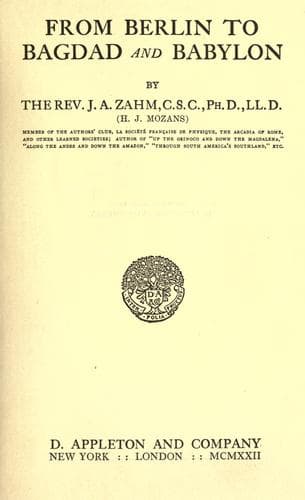
From Berlin to Bagdad and BabylonZahm, J. A. (John Augustine)
HistoryChristian
From Berlin to Bagdad and Babylon
Zahm, J. A. (John Augustine)
Middle East -- Civilization; Middle East -- Description and travel
What greatly contributed towards the rapid development of Bagdad and
towards making it the great emporium of the East, was the admirable
system of canals which intersected the rich alluvial plains of lower
Babylonia and which enabled the inhabitants of this region to utilize
the surplus waters of the Euphrates for irrigating the fertile lands
which lay between this river and the Tigris. Contrary to what is so
often thought, the Arabs, under the Caliphs, gave as much attention to
the canalization of Mesopotamia as had their predecessors, the Persians
and the Babylonians.
But these canals, besides being used for purposes of irrigation,
likewise served for the transportation of merchandise from distant
regions. Thus, to give a single instance of their use for this purpose,
we are informed that “great boats and barges were loaded at Rakkah,
‘the port,’ as it was called, of the Syrian desert on the Upper
Euphrates, there taking over from the land-caravans the corn of Egypt
and the merchandise from Damascus; and these boats, coming down the
great river, and then along the Isa Canal, discharged their cargoes at
the wharves on the Tigris banks at the lower harbor in Karkh.”[427]
To give some idea of the fertility of the irrigated region of
Mesopotamia during the reign of the Caliphs it suffices to quote the
words of an Arabic writer regarding certain cornlands in the vicinity
of Bagdad, where, we are told, “the crops never failed, neither in
winter nor in summer,” and of the report given of a certain mill in
which there were no fewer than a hundred millstones which produced the
extraordinary annual rental of a hundred million dirhams, a sum that
was equivalent to several million dollars of our money.
Marco Polo, that king of mediæval travelers, who, by the vast compass
of his journeys, was better qualified than any man of his time to
express an opinion on the relative importance of the cities of Asia,
declares that Bagdad--which he calls Baudas--is “the noblest and
greatest city of these regions” and that it “used to be the seat of
the Caliph of all the Saracens in the world, just as Rome is the
seat of the Pope of all the Christians.”[428] But the illustrious
Venetian voyager did not visit Bagdad until several decades after the
destruction of the city by the Mongol hordes under Hulagu Khan.
Public-domain text, read in full here on John Shaqi.
Reviews
Reviews
No reviews yet
Be the first to share your thoughts on this work.
Elsewhere in the archive
Join the Discussion
Join the discussion
Sign in to leave a comment or review.
Sign InorCreate an account