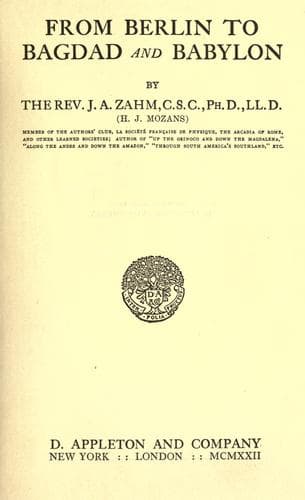
From Berlin to Bagdad and BabylonZahm, J. A. (John Augustine)
HistoryChristian
From Berlin to Bagdad and Babylon
Zahm, J. A. (John Augustine)
Middle East -- Civilization; Middle East -- Description and travel
It is not within the scope of this chapter to give even a brief
description of Constantinople. That is rendered quite unnecessary
by the scores of valuable books which have been written on this
fascinating subject. This, however, does not mean that I was not
intensely interested in its countless attractions or that they
did not make deep impressions on me and give rise to serious
reflections. Far from it. I spent every available hour in visiting its
churches, mosques, schools, museums and in contemplating its hoary,
lichen-covered ruins, its battlemented walls and ivy-festooned towers
which, for long ages, cast their trembling shadows on the glimmering
waters of the Sea of Marmora and served, for more than eleven hundred
years, as effective bulwarks against the fierce assaults of Avars and
Goths, Arabs and Persians, Slavonians and Bulgarians and Mongols.
And, as I threaded my way through its narrow and devious streets and
inspected the picturesque and tumble-down houses, I found special
pleasure in scrutinizing the letters and inscriptions and epitaphs
engraved on slabs of marble or on blocks of granite, some of which
were in their original position while others had been used in the
construction of some now crumbling wall or building. If they could
speak, what stories could not these disconnected letters and incomplete
inscriptions tell of the shadowy past--stories of dark and strange
events connected with sieges and conquests--stories of intrigue and
deeds of violence and tyranny in which ambitious eunuchs, heartless
pashas, and bloodthirsty sultans were the chief actors--stories, too,
of exalted virtue and heroism displayed by noble men and women that
time the fanatic followers of Mohammed boastfully announced their
intention to plant the Crescent over the Cross and to remove from the
devoted city of Constantine the last vestiges of Christian art and
culture.
The first object to claim my attention after arriving in Constantinople
was the majestic and solemn church, now a mosque, of Santa Sophia. To
the Greeks it is known as the church of Hagia Sophia--Divine Wisdom.
More frequently, however, it is called ’Η Μεγάλη Εκκλησία--“The Great
Church--the church _par excellence_.”
Exteriorly this masterpiece of Byzantine basilicas has the aspect of
a massive, irregular time-worn fortress. Surrounded by all kinds of
low, unsymmetrical buildings--shops, storehouses, baths, schools,
turbehs--one can have no idea of its original design or external
appearance as it came from the hands of its architects, Anthemius of
Tralles and Isidore of Miletus.
Public-domain text, read in full here on John Shaqi.
Reviews
Reviews
No reviews yet
Be the first to share your thoughts on this work.
Join the Discussion
Join the discussion
Sign in to leave a comment or review.
Sign InorCreate an account