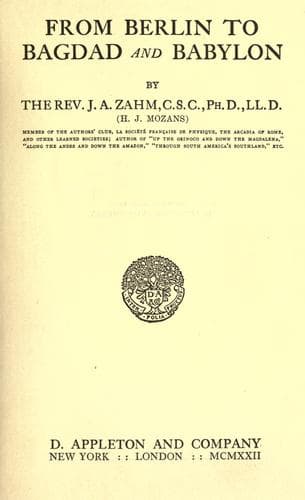
From Berlin to Bagdad and BabylonZahm, J. A. (John Augustine)
HistoryChristian
From Berlin to Bagdad and Babylon
Zahm, J. A. (John Augustine)
Middle East -- Civilization; Middle East -- Description and travel
At all these places, as on the site of Troy’s citadel, I loved to
recall the Greeks’ love of beauty and the marvelous mythopœic faculty
of their poets, and it required no spur to fancy to imagine that I was,
for the moment, in actual communion with the thoughts and feelings of
the world’s masters of beauty in art and literature.
The plain of Troy [it has been said] has been a battlefield not
only of heroes, but of scholars and geographers, and the works
which have been written on the subject form a literature to
themselves.[74]
This is true. But, however much students of the _Iliad_ may have
disagreed about the location of the city of Priam, about the courses
of the Simois and Scamander and certain minor details, all have been
compelled to recognize the accuracy of the poet’s topographical
descriptions and the appropriateness of the epithets which he applies
to the most striking features of the enchanting landscape which he
so graphically depicts. He does not, of course, give the numbers and
distances, as some of his critics would seem to demand, that a civil
engineer would require for a contour-line map. This would violate
entirely the most elementary canons of poetical treatment. But he does
use numbers and distances so far as they are necessary to give reality
to the action of the poem. And though his realities are in the highest
degree idealized, nevertheless, so fully do they meet the general
exigencies of time and place that they prove almost to demonstration
that Homer was thoroughly familiar not only with Troy but also with
all the surrounding region.[75]
The epithets applied by the poet to the mountains, islands, rivers,
and other natural features described in his matchless work show that
he must have been intimately acquainted with them, not by hearsay but
by personal inspection. Thus when he speaks of the “rapid current” of
the Hellespont, of the “broad-flowing” and “eddying” Scamander, of
“the peak of lofty Samothrace appearing over the intervening mass of
Imbros,” thus enabling Poseidon to look down from its summit on the
plain of Troy, we are convinced that the author of the _Iliad_
had carefully examined on the spot the objects he so vividly brings
before our view. And so it is in his graphic delineations of “lofty,”
“many-fountained” Ida, of “many-crested,” “dazzling”
_Olympus, the reputed seat_
_Eternal of the gods, which never storms_
_Disturb, rains drench, or snow invades, but calm._
So graphic and exact indeed are the epithets and descriptions of Homer
that they far surpass those of the later poets of Greece. In this
respect he constantly reminds one of Dante, that consummate master
of epithet and of brief but most exact description, who had the rare
faculty of expressing the import of a whole sentence in a single word.
I was then more than ever before impressed with the truth of Gœthe’s
words:
_Wer den Dichter will verstehen_
_Muss in Dichter’s Lande gehen._[76]
Public-domain text, read in full here on John Shaqi.
Reviews
Reviews
No reviews yet
Be the first to share your thoughts on this work.
Elsewhere in the archive
Join the Discussion
Join the discussion
Sign in to leave a comment or review.
Sign InorCreate an account