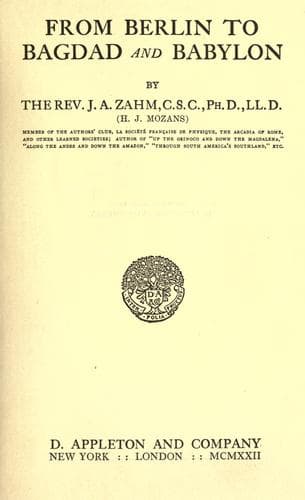
From Berlin to Bagdad and BabylonZahm, J. A. (John Augustine)
HistoryChristian
From Berlin to Bagdad and Babylon
Zahm, J. A. (John Augustine)
Middle East -- Civilization; Middle East -- Description and travel
Although I had always been specially interested in Greek archæology I
felt no inclination, during my short visit to Troy, to indulge my taste
for archæological pursuits. I was satisfied to accept the conclusions
of Schliemann and Dorpfeld and Virchow respecting the location of
Ilium and the bearing of their discoveries on the reality of Homer
and the Trojan war. And, as I roamed the plain on which the Greek
army was encamped, I could not help hoping that further investigation
would prove that the startling discoveries of Schliemann at Mycenæ
would remove the last vestiges of doubt regarding the actual existence
of Agamemnon and Cassandra.[81] This would be a tangible proof of
the reality of at least one of Homer’s heroes. It would, too, be a
most interesting contribution to the Homeric question and would be
specially gratifying to those who, in spite of certain modern critics,
have unfalteringly clung to the views concerning Homer, Troy, and
the _Iliad_ which have universally prevailed since the days of
Aristarchus and the Homeridæ.
The blind bard of Chios then is to-day, as he always has been, as he
always will be so long as men shall love supreme excellence in letters,
a living personality whose wonderful epics have exercised a wider and
a more potent influence on the intellectual progress of our race than
all other epics combined. No books, except perhaps those of the Bible,
have been more frequently quoted nor have any received more attention
from poets, orators, dramatists, and lovers of the noblest models of
literary style.
Another remarkable fact is the gift of immortality which Homer, with
Jovelike power, has conferred upon his heroes. Although but the
creations of the poet’s genius, they stand forth to-day, men of flesh
and blood, in all the vigor and freshness which characterized them
thirty centuries ago. And there never have been among the children of
men any who are better known, or whose names more frequently occur
in song and story than the undying characters of the _Odyssey_
and the _Iliad_. These facts impress every lover of Homer as he
surveys the plain of Troy from the spot on which stood the Pergamus
and recollects the achievements of the blind bard’s heroes during the
ten long years of the Trojan war.
And, like Achilles and Agamemnon, Priam and Hector, the Troy of Homer
also is immortal. Notwithstanding the efforts of a jealous Demetrius
or an ill-informed Le Chevalier to transfer the glory of Troy to some
other locality, its claims, as Schliemann has shown, still stand on as
firm a basis as ever. Yes, of a truth,
_Thou livest, O Troy, forever unto men._
* * * * *
Public-domain text, read in full here on John Shaqi.
Reviews
Reviews
No reviews yet
Be the first to share your thoughts on this work.
Elsewhere in the archive
Join the Discussion
Join the discussion
Sign in to leave a comment or review.
Sign InorCreate an account