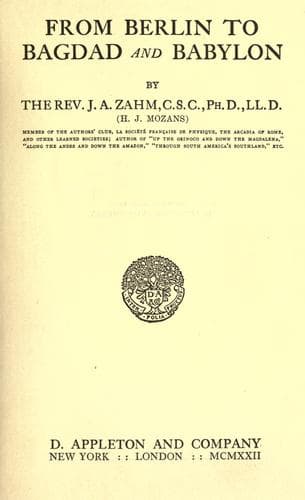
From Berlin to Bagdad and BabylonZahm, J. A. (John Augustine)
HistoryChristian
From Berlin to Bagdad and Babylon
Zahm, J. A. (John Augustine)
Middle East -- Civilization; Middle East -- Description and travel
The dancing waves of the Marmora, as they gently lap along its curving
shore, are as soothing as a lullaby to a cradled child. And all the
while they are murmuring the same old story that greeted the ears of
the seafaring Megarians as they passed by nearly three thousand years
ago and which reached the crews of the trim Venetian argosies whose
arms proudly floated on their flags and pennants as they conveyed
the treasures of India and China from the ports of the Euxine to the
gem-blue haven of the peerless Queen of the Adriatic. The noonday sun,
playing over the rippling waters, changes them in rapid succession from
the delicate color of the lapis lazuli to the scintillating iridescence
of the opal.
Along the coast line one contemplates with ever-increasing delight
countless views of entrancing beauty and interest--gray moss-covered
rocks which are ever of tender loveliness and reposeful silence;
trembling vines and waving figs and olives and oranges; picturesque
adobe cottages adorned with graceful creepers; romping children who
make the air ring with their joyous shouts; men and women in the most
colorful garbs quietly performing their daily tasks and all the while
completely immune from the feverish haste that so distracts the toiling
millions of Europe and America and converts their life into a long and
troubled nightmare. The secret is that the normal Osmanli peasant is
satisfied with little. Permit him to cultivate his small plot of ground
in peace and to remain undisturbed in the bosom of his family and he is
perfectly happy. Under such conditions he would find nothing to envy
even in the lot of the denizens of the Happy Valley.
On our arrival at Ismid we were reminded that we were traveling over
classic ground. For this small Turkish town was under the Roman Empire
one of the largest cities in Asia Minor. It was here that Diocletian
had his seat of Government; it was here that he began his sanguinary
persecutions against the Christians and it was here that he abdicated
the throne. It was in his imperial villa near here that death claimed
Constantine the Great and it was in a neighboring castle that Hannibal
committed suicide. And Nicomedia was the birthplace of Arrian, the
illustrious disciple of Epictetus, who, from notes of his master’s
lectures, prepared the famed _Discourses of Epictetus_. He also
wrote the scarcely less celebrated _Anabasis of Alexander the
Great_.
Public-domain text, read in full here on John Shaqi.
Reviews
Reviews
No reviews yet
Be the first to share your thoughts on this work.
Elsewhere in the archive
Join the Discussion
Join the discussion
Sign in to leave a comment or review.
Sign InorCreate an account