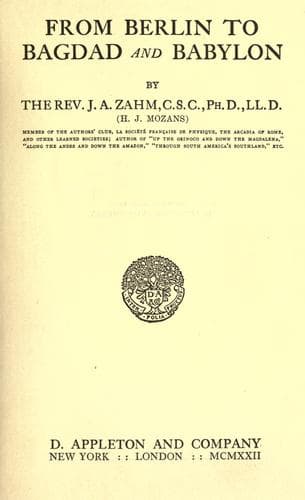
From Berlin to Bagdad and BabylonZahm, J. A. (John Augustine)
HistoryChristian
From Berlin to Bagdad and Babylon
Zahm, J. A. (John Augustine)
Middle East -- Civilization; Middle East -- Description and travel
Our first stop, however, was at the little town of Lefke where we found
waiting for us an _araba_ which we had ordered the day previously
to take us to Isnik--about four hours’ drive from the railroad--which
is but a small village of mud houses, but which during Roman and
Byzantine times was, under the name of Nicæa, the rival of Nicomedia.
Even while in the possession of the Sultans of Rum it was as a center
of art, poetry, and science scarcely less renowned than Cordova and
Bagdad. And while Constantinople was in the possession of the Latins,
after its capture by the Crusaders, Nicæa served as the temporary
capital of the Byzantine Empire.
There are few places in Anatolia which make a stronger appeal to the
student than the ancient city of Nicæa. Its ivy and fern-covered ruins,
walls, baths, theaters, churches, mosques, towers, gates, aqueducts,
sarcophagi, bas-reliefs, and inscriptions of all kinds are in the
highest degree interesting and offer a mine of most precious material
for the antiquary or the historian.
To us Nicæa was a
_Relic of nobler days and noblest arts_,
and, as we wandered among the ruin-covered streets of the once famous
city, we seemed to hear the monitory words
_Lightly tread, ’tis hallowed ground._
But my object in visiting this famous place was not knowledge so much
as impressions. I was attracted thither by the same magnet that drew
me to Troy and Chalcedon. I wished to get the local color and secure a
local picture of a place which has filled an important page in history
and which for centuries was the goal of contending armies--Asiatics and
Europeans, Moslems and Christians. But the predominant reason for my
visit to this scene of ruins was the fact that it had been a witness of
two of the Church’s most noted œcumenical councils.
The first council which was held here in 325 was likewise the first
General Council of the Church. It is noted for its condemnation
of Arianism and for the formation of the Nicene Creed which, as
subsequently amplified by the Council of Constantinople, has ever since
been the symbol of faith used not only by the Catholic Church but also
by those Eastern Churches which are no longer in communion with Rome
and by many of the Protestant Churches as well.
Public-domain text, read in full here on John Shaqi.
Reviews
Reviews
No reviews yet
Be the first to share your thoughts on this work.
Elsewhere in the archive
Join the Discussion
Join the discussion
Sign in to leave a comment or review.
Sign InorCreate an account