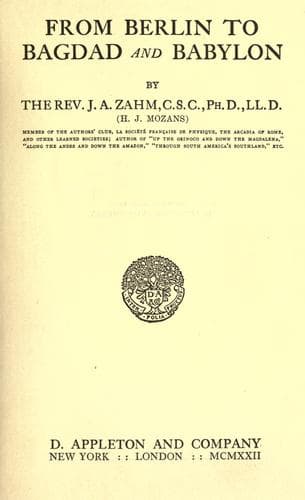
From Berlin to Bagdad and BabylonZahm, J. A. (John Augustine)
HistoryChristian
From Berlin to Bagdad and Babylon
Zahm, J. A. (John Augustine)
Middle East -- Civilization; Middle East -- Description and travel
In the second council of Nicæa, which was the seventh of the Church’s
general councils and which convened in 787, was condemned the doctrine
of the Iconoclasts, which so long agitated the Eastern Church and
which was the cause of so many relentless persecutions throughout
the whole of the Byzantine Empire. Even Moslems, who regard every
kind of representation of the human form as an execrable idol, could
not have been more fanatical and pitiless in their dealings with
anti-Iconoclasts than were Leo the Isaurian, who was suspected of
favoring Islamism, and his son Constantine Copronymus. During their
reigns, not to speak of those of several of their successors, the
churches of the Byzantine Empire were as bare of images and statues as
were the mosques of Medina and Damascus.[88]
By a peculiar combination of events it fell to the lot of two
women--the Empresses Irene and Theodora--to undo the work of the
Iconoclastic emperors and to put a stop to the persecutions which had
caused the exile, the imprisonment, or the death of countless numbers
of the noblest men and women of the empire, whose only offense was
fidelity to the faith of their fathers.
Few things in Anatolia are more competent to awaken memories of the
past glories of Asia Minor than a visit to the spot that on two
momentous occasions witnessed the assemblage of hundreds of bishops
from both the Orient and the Occident. What a contrast between the
present condition of Nicæa and that at the time when the assembled
fathers subscribed to that creed which has ever since been accepted as
the symbol of faith of nearly the whole of Christendom!
In Asia Minor alone there were, in the fifth century, no fewer than
four hundred and fifty episcopal sees. And an imperial law was enacted
that every city should have its own bishop--_unaquœque civitas
proprium episcopum habeto_.[89] But what a change has come over
this once flourishing portion of the Christian Church. The famous
cities--Nicæa, Chalcedon, and Ephesus--in which four general councils
were held and which in Roman times were all capitals of provinces--have
long since been reduced to ruins. So completely, indeed, had Ephesus
disappeared from sight that little was known even about its topography
until the Austrian Archæological Institute began its excavations there
but little more than two decades ago.
And so it is throughout the length and the breadth of Anatolia.[90]
Great and popular cities, which, in the heyday of the Roman Empire
were noted for their splendid temples, baths, gymnasia, colonnades,
Greek theaters, and Roman amphitheaters, which were all graced by
masterpieces of art in marble and bronze--frequently replicas of
matchless Greek originals--are now either entirely deserted or tenanted
by a few nomadic shepherds or poor tillers of the soil whose only homes
are small mud hovels that barely protect them from the elements.
Public-domain text, read in full here on John Shaqi.
Reviews
Reviews
No reviews yet
Be the first to share your thoughts on this work.
Elsewhere in the archive
Join the Discussion
Join the discussion
Sign in to leave a comment or review.
Sign InorCreate an account