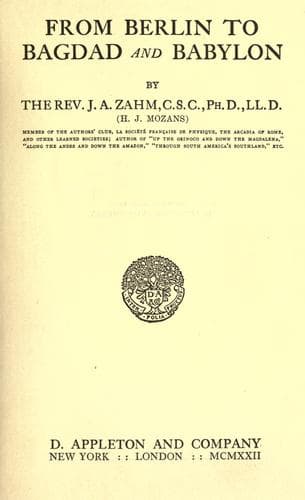
From Berlin to Bagdad and BabylonZahm, J. A. (John Augustine)
HistoryChristian
From Berlin to Bagdad and Babylon
Zahm, J. A. (John Augustine)
Middle East -- Civilization; Middle East -- Description and travel
One need spend but little time in Anatolia to find that the men among
the Osmanlis are a most lovable people. What first impresses one is
their good manners. Whether they live in a palace or a hovel they are
always self-respecting, courteous, and dignified. In this respect
they continually remind one of the people of Spain where courtesy is a
national heritage. It was this striking characteristic of the Osmanli
that led Bismarck to declare:
In the Orient the only gentleman is the Turk.[126]
Another national characteristic of the Osmanlis is cleanliness.
Their homes, however humble, are as scrupulously swept and scrubbed
as a Dutch dwelling place.[127] And the same may be said of their
coffeehouses and restaurants. In this respect they are in marked
contrast with those of the Greeks and Arabs.
Many writers have endeavored to account for the exceptional courtesy
and cleanliness of the Osmanlis, but the reasons usually advanced
are far from satisfactory. “Their religion,” writes Sir Edwin Pears,
“inculcates cleanliness and sobriety; ... it has helped to diffuse
courtesy and self-respect among its adherents.”[128]
If this were true it should hold good for the Moslems of Egypt and
Morocco which, as all travelers in these countries know, is very often
far from the case. When we shall be able to assign a reason for the
matchless courtesy of the Castilian hidalgo or for the Dutch hausfrau’s
singular love of cleanliness, we shall probably find an acceptable
explanation of the seemingly innate courtesy and cleanliness of the
Osmanlis of Anatolia.
And contrary to almost universal belief, the Osmanlis, both men and
women are a people of very industrious habits. This is particularly
true of those who make their living by tilling the soil and by tending
their flocks and herds. So far as the men are concerned the traveler
has ample evidence of their toilsome lives from the time he leaves
the swift-flowing Bosphorus until he arrives at the foothills of the
picturesque Taurus. As to the women they are, according to those who
know them best, as laborious as the men. A competent witness, one who
is himself an Ottoman, who was born and bred in Anatolia and whose
testimony regarding the domestic life of his countrymen bears the
clearest impress of truth, is the clever and entertaining Halil Halid
who, having spent many years in England, writes English as a native.
Speaking of his countrywomen he declares:
No qualities are so much sought after in average marriageable
women as the domestic ones. In the provinces the peasant women,
besides managing their humble domestic affairs, have to work in
the fields, more especially when their brothers and husbands
are away discharging their compulsory military service. The
daughters of well-to-do people, besides attending to the
business of their households, are indefatigable with their
needles and are always busy with needle work or embroidery.[129]
Public-domain text, read in full here on John Shaqi.
Reviews
Reviews
No reviews yet
Be the first to share your thoughts on this work.
Elsewhere in the archive
Join the Discussion
Join the discussion
Sign in to leave a comment or review.
Sign InorCreate an account