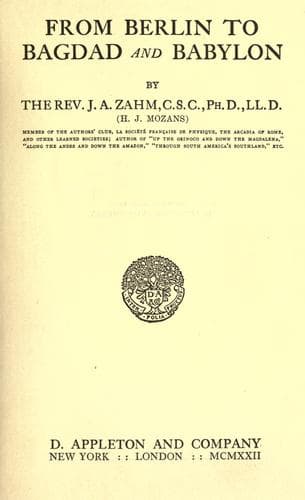
From Berlin to Bagdad and BabylonZahm, J. A. (John Augustine)
HistoryChristian
From Berlin to Bagdad and Babylon
Zahm, J. A. (John Augustine)
Middle East -- Civilization; Middle East -- Description and travel
Knolles says, “You seldom see a murder or a theft committed by any
Turk.” European gentlemen accustomed to the barbarous custom of wearing
swords on all occasions, were surprised to see Turks of the highest
rank, distinguished for their valor and military exploits, walking
about even in provincial towns, unarmed, secure in the power of public
order and the protection of the executive authority in the State.[140]
But, it is asked, do not the reported atrocities of the Turks in
Armenia and the Balkans prove that their reputation for the most
frightful deeds of savagery is established beyond peradventure? An
adequate answer to this question would lead us too far afield, for
the Osmanlis, unlike their enemies, have few champions or political
knights-errant, and our information, therefore, respecting the
atrocities in question is almost entirely one-sided. To those, however,
who are desirous of reading the Ottoman side of the question I would
recommend the thoroughly documented work of Pierre Loti entitled
_Turquie Agonisante_.[141] A careful perusal of this work will
convince any impartial reader that in this, as in every other question,
“the unspeakable Turk” is far from being “the homicide of all human
kind” he is so frequently pictured to be.
I would not, however, have it inferred from the foregoing pages that I
ignore the corruption and organized bribery and the extent to which the
government is made to subserve the interests of those who govern rather
than those who are governed. This condition has existed in Turkey from
time immemorial, not only in the administration of governmental affairs
but in the administration of justice as well. But it is, unfortunately,
a condition that exists in all parts of the Orient from Constantinople
to Peking.[142]
Nor am I blind to the incalculable miseries to which the peasantry
of Anatolia are exposed by the ravenous tax-gatherers who rob them
of their little savings and keep many of them in constant penury.
The exactions and cruelties of these soulless agents of Turkish
misrule are almost incredible. It is these oppressive measures of
Turkish maladministration, coupled with the opening of the Suez Canal,
which have done much to close the overland trade routes to which
Anatolia owed much of its former prosperity. It is to be hoped that
the reorganized Ottoman government will succeed in eliminating the
crying evils here indicated, but they are of so long standing that
statesmanship of the highest order will be required to deal with a
situation which is now almost desperate.
Public-domain text, read in full here on John Shaqi.
Reviews
Reviews
No reviews yet
Be the first to share your thoughts on this work.
Elsewhere in the archive
Join the Discussion
Join the discussion
Sign in to leave a comment or review.
Sign InorCreate an account