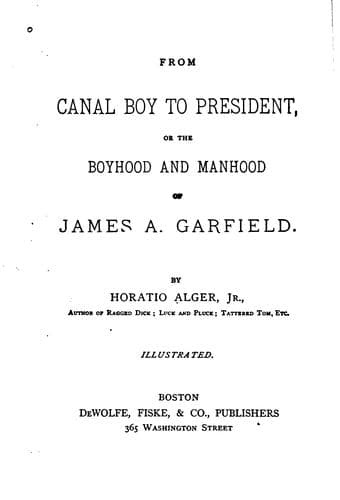
From Canal Boy to President; Or, the Boyhood and Manhood of James A. GarfieldAlger, Horatio, Jr.
History
From Canal Boy to President; Or, the Boyhood and Manhood of James A. Garfield
Alger, Horatio, Jr.
Garfield, James A. (James Abram), 1831-1881 -- Childhood and youth; Presidents -- United States -- Biography
But when, after the delay of four years, he was elected to the Senate,
he accepted with a feeling of satisfaction--not so much because he was
promoted as because, in his new sphere of usefulness, he would have more
time for the gratification of his literary tastes.
In a speech thanking the members of the General Assembly for their
support, he said:
"And now, gentlemen of the General Assembly, without distinction of
party, I recognize this tribute and compliment paid to me to-night.
Whatever my own course may be in the future, a large share of the
inspiration of my future public life will be drawn from this occasion
and from these surroundings, and I shall feel anew the sense of
obligation that I feel to the State of Ohio. Let me venture to point a
single sentence in regard to that work. During the twenty years that I
have been in public life, almost eighteen of it in the Congress of the
United States, I have tried to do one thing. Whether I was mistaken or
otherwise, it has been the plan of my life to follow my conviction at
whatever cost to myself.
"I have represented for many years a district in Congress whose
approbation I greatly desired; but, though it may seem, perhaps, a
little egotistical to say it, I yet desired still more the approbation
of one person, and his name was Garfield. [Laughter and applause]. He is
the only man that I am compelled to sleep with, and eat with, and live
with, and die with; and, if I could not have his approbation, I should
have had companionship. [Renewed laughter and applause]. And in this
larger constituency which has called me to represent them now, I can
only do what is true to my best self, following the same rule. And if I
should be so unfortunate as to lose the confidence of this larger
constituency, I must do what every other fair-minded man has to
do--carry his political life in his hand and take the consequences. But
I must follow what seems to me to be the only safe rule of my life; and
with that view of the case, and with that much personal reference, I
leave that subject."
This speech gives the key-note of Garfield's political action. More than
once he endangered his re-election and hazarded his political future by
running counter to what he knew to be the wishes of his constituents and
his party; but he would never allow himself to be a slave to party, or
wear the yoke of political expediency. He sought, first of all, to win
the approval of his own conscience and his own sense of right, and then
he was willing to "take the consequences," even if they were serious
enough to cut short the brilliant career which he so much enjoyed.
I conceive that in this respect he was a model whom I may safely hold up
for the imitation of my readers, young or old. Such men do credit to the
country, and if Garfield's rule of life could be universally adopted,
the country would never be in peril. A conscientious man may make
mistakes of judgment but he can never go far astray.
CHAPTER XXXI.
Public-domain text, read in full here on John Shaqi.
Reviews
Reviews
No reviews yet
Be the first to share your thoughts on this work.
Elsewhere in the archive
Join the Discussion
Join the discussion
Sign in to leave a comment or review.
Sign InorCreate an account