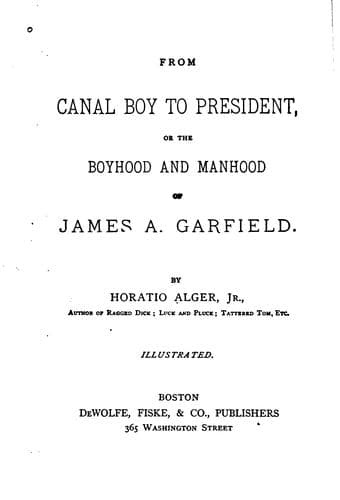
From Canal Boy to President; Or, the Boyhood and Manhood of James A. GarfieldAlger, Horatio, Jr.
History
From Canal Boy to President; Or, the Boyhood and Manhood of James A. Garfield
Alger, Horatio, Jr.
Garfield, James A. (James Abram), 1831-1881 -- Childhood and youth; Presidents -- United States -- Biography
THE TRIBUTES OF FRIENDS.
Before going farther, in order that my young readers may be better
qualified to understand what manner of man Garfield was, I will quote
the remarks made by two of his friends, one a prominent member of the
party opposed to him in politics. In the Milwaukee _Sentinel_ of Sept.
22d, I find this tribute by Congressman Williams, of that State:
"Happening to sit within one seat of him for four years in the House, I,
with others, perhaps had a better opportunity to see him in all of his
moods than those more removed. In action he was a giant; off duty he was
a great, noble boy. He never knew what austerity of manner or
ceremonious dignity meant. After some of his greatest efforts in the
House, such as will live in history, he would turn to me, or any one
else, and say: 'Well, old boy, how was that?' Every man was his
confidant and friend, so far as the interchange of every-day good
feeling was concerned.
"He once told me how he prepared his speeches; that first he filled
himself with the subject, massing all the facts and principles involved,
so far as he could; then he took pen and paper and wrote down the
salient points in what he regarded their logical order. Then he scanned
them critically, and fixed them in his memory. 'And then,' said he, 'I
leave the paper in my room and trust to the emergency.' He told me that
when he spoke at the serenade in New York a year ago, he was so pressed
by callers that the only opportunity he had for preparation was, to lock
the door and walk three times around the table, when he was called out
to the balcony to begin. All the world knows what that speech was.
"He was wrapped up in his family. His two boys would come up to the
House just before adjournment, and loiter about his desk with their
books in their hands. After the House adjourned, other members would go
off in cars or carriages, or walk down the avenue in groups. But
Garfield, with a boy on each side of him, would walk down Capitol Hill,
as we would say in the country 'cross-lots,' all three chatting
together on equal terms.
"He said to me one day during the canvass, while the tears came to his
eyes, 'I have done no more in coming up from poverty than hundreds and
thousands of others, but I am thankful that I have been able to keep my
family by my side, and educate my children.'
"He was a man with whom anybody could differ with impunity. I have said
repeatedly, that were Garfield alive and fully recovered, and a dozen of
his intimate friends were to go to him, and advise that Guiteau be let
off, he would say, 'Yes, let him go.' The man positively knew no malice.
And for such a man to be shot and tortured like a dog, and by a dog!
Public-domain text, read in full here on John Shaqi.
Reviews
Reviews
No reviews yet
Be the first to share your thoughts on this work.
Elsewhere in the archive
Join the Discussion
Join the discussion
Sign in to leave a comment or review.
Sign InorCreate an account