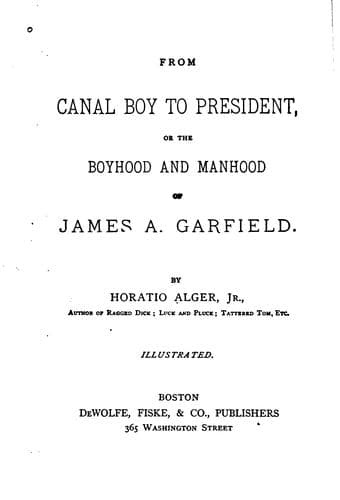
From Canal Boy to President; Or, the Boyhood and Manhood of James A. GarfieldAlger, Horatio, Jr.
History
From Canal Boy to President; Or, the Boyhood and Manhood of James A. Garfield
Alger, Horatio, Jr.
Garfield, James A. (James Abram), 1831-1881 -- Childhood and youth; Presidents -- United States -- Biography
"CLASSMATES: To me there is something exceedingly pathetic in this
reunion. In every eye before me I see the light of friendship and love,
and I am sure it is reflected back to each one of you from my inmost
heart. For twenty-two years, with the exception of the last few days, I
have been in the public service. To-night I am a private citizen.
To-morrow I shall be called to assume new responsibilities, and on the
day after, the broadside of the world's wrath will strike. It will
strike hard. I know it, and you will know it. Whatever may happen to me
in the future, I shall feel that I can always fall back upon the
shoulders and hearts of the class of '56 for their approval of that
which is right, and for their charitable judgment wherein I may come
short in the discharge of my public duties. You may write down in your
books now the largest percentage of blunders which you think I will be
likely to make, and you will be sure to find in the end that I have made
more than you have calculated--many more.
"This honor comes to me unsought. I have never had the Presidential
fever--not even for a day; nor have I it to-night. I have no feeling of
elation in view of the position I am called upon to fill. I would thank
God were I to-day a free lance in the House or the Senate. But it is
not to be, and I will go forward to meet the responsibilities and
discharge the duties that are before me with all the firmness and
ability I can command. I hope you will be able conscientiously to
approve my conduct; and when I return to private life, I wish you to
give me another class-meeting."
This brief address exhibits the modesty with which Gen. Garfield viewed
his own qualifications for the high office for which twenty years of
public life had been gradually preparing him. While all are liable to
mistakes, it is hardly to be supposed that a man so prepared, and
inspired by a conscientious devotion to what he deemed to be right,
would have made many serious blunders. During his brief administration
he made, as the country knows, an admirable beginning in reforming
abuses and exacting the most rigid economy in the public service. There
was every probability of his being his own successor had his life been
spared.
The inaugural ceremonies were very imposing. Washington was thronged as
it had never been before on any similar occasion. Private citizens,
civic bodies, and military companies were present from every part of
the country. Prominent among the eminent citizens present was the
stately and imposing figure of Gen. Hancock, who had been the nominee of
the opposing party, and who, with admirable good feeling and good taste,
had accepted an invitation to be present at the inauguration of his
successful rival.
Public-domain text, read in full here on John Shaqi.
Reviews
Reviews
No reviews yet
Be the first to share your thoughts on this work.
Elsewhere in the archive
Join the Discussion
Join the discussion
Sign in to leave a comment or review.
Sign InorCreate an account