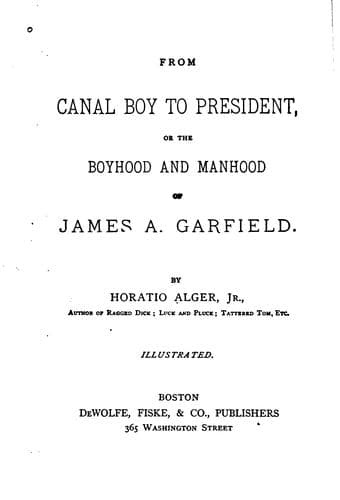
From Canal Boy to President; Or, the Boyhood and Manhood of James A. GarfieldAlger, Horatio, Jr.
History
From Canal Boy to President; Or, the Boyhood and Manhood of James A. Garfield
Alger, Horatio, Jr.
Garfield, James A. (James Abram), 1831-1881 -- Childhood and youth; Presidents -- United States -- Biography
And there were others present whom we have met before. The wife and
mother of the new President, with flushed cheeks and proud hearts,
witnessed the ceremonies that made the one they loved the head of the
State. To him they were more than all the rest. When he had taken the
oath of office in the presence of the assembled tens of thousands,
Garfield turned to his aged mother and imprinted a kiss upon her cheek,
and afterward upon that of his wife. It was a touch of nature that
appealed to the hearts of all present.
In the White House, one of the best rooms was reserved for his aged
mother, for whom he cherished the same fond love and reverence as in his
boyish days. It was a change, and a great one, from the humble log-cabin
in which our story opens; it was a change, too, from the backwoods boy,
in his suit of homespun, to the statesman of noble and commanding
figure, upon whom the eyes of the nation were turned. The boy who had
guided the canal-boat was now at the helm of the national vessel, and
there was no fear that he would run her aground. Even had storms come,
we might safely trust in him who had steered the little steamboat up the
Big Sandy River, in darkness and storm and floating obstructions, to the
camp where his famished soldiers were waiting for supplies. For, as is
the case with every great man, it was difficulty and danger that nerved
Garfield to heroic efforts, and no emergency found him lacking.
His life must now be changed, and the change was not altogether
agreeable. With his cordial off-hand manners, and Western freedom, he,
no doubt, felt cramped and hampered by the requirements of his new
position. When he expressed his preference for the position of a
freelance in the House or Senate, he was sincere. It was more in
accordance with his private tastes. But a public man can not always
choose the place or the manner in which he will serve his country.
Often she says to him, "Go up higher!" when he is content with an humble
place, and more frequently, perhaps, he has to be satisfied with an
humble place when he considers himself fitted for a higher.
So far as he could, Gen. Garfield tried to preserve in the Executive
Mansion the domestic life which he so highly prized. He had his children
around him. He made wise arrangements for their continued education, for
he felt that whatever other legacy he might be able to leave them, this
would be the most valuable. Still, as of old, he could count on the
assistance of his wife in fulfilling the duties, social and otherwise,
required by his exalted position.
Public-domain text, read in full here on John Shaqi.
Reviews
Reviews
No reviews yet
Be the first to share your thoughts on this work.
Elsewhere in the archive
Join the Discussion
Join the discussion
Sign in to leave a comment or review.
Sign InorCreate an account