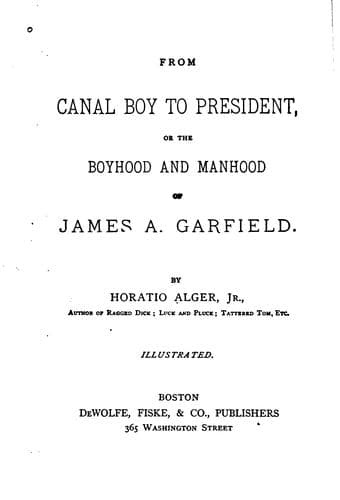
From Canal Boy to President; Or, the Boyhood and Manhood of James A. GarfieldAlger, Horatio, Jr.
History
From Canal Boy to President; Or, the Boyhood and Manhood of James A. Garfield
Alger, Horatio, Jr.
Garfield, James A. (James Abram), 1831-1881 -- Childhood and youth; Presidents -- United States -- Biography
It was a gratifying compliment, for in our country an election to
Congress is regarded as a high honor, which no one need be reluctant to
accept. We have on record one of our most distinguished statesmen--John
Quincy Adams--who, after filling the Presidential chair, was content to
go back to Washington as a member of the House of Representatives from
his district in Massachusetts. It was undoubtedly more in harmony with
the desires and tastes of the young man--for he was still a young
man--than service in the field. But he felt that that was not the
question. Where was he more needed? The war was not over. Indeed, it
seemed doubtful when it would be finished; and Garfield was now in a
position to serve his country well as a military commander.
When on the march to Chattanooga, Garfield consulted Gen. Rosecranz,
owning that he was perplexed in attempting to decide.
Rosecranz said: "The war is not yet over, nor will it be for some time
to come. Many questions will arise in Congress which will require not
only statesman-like treatment, but the advice of men having an
acquaintance with military affairs. For that reason you will, I think,
do as good service to the country in Congress as in the field. I not
only think that you can accept the position with honor, but that it is
your duty to do it."
He added, and we may be sure that his advice accorded with the personal
judgment of the man whom he was addressing, "Be true to yourself, and
you will make your mark before your country."
Some months were to elapse before he would require to go to Washington,
for Congress was not to meet till December.
He went to Washington, undecided even yet whether to remain as a
legislator, or to return to his old comrades in the army. He only wished
to know where he could be of most service to his country, and he finally
decided to lay the matter before President Lincoln.
Lincoln gave substantially the same advice as Rosecranz: "We need men
who will help us carry the necessary war measures; and, besides, we are
greatly lacking in men of military experience in the House to promote
legislation about the army. It is your duty, therefore, to enter
Congress."
When, on the 5th of December, 1863, Garfield took his seat in the House
of Representatives, he was the youngest member of that body. The
Military Committee was the most important committee of Congress, and he
was put upon that, on account of his practical experience in the field.
This, of course, brought him, though a new and young member, into
immediate prominence, and his familiarity with the wants of the army
enabled him to be of great service.
Public-domain text, read in full here on John Shaqi.
Reviews
Reviews
No reviews yet
Be the first to share your thoughts on this work.
Elsewhere in the archive
Join the Discussion
Join the discussion
Sign in to leave a comment or review.
Sign InorCreate an account