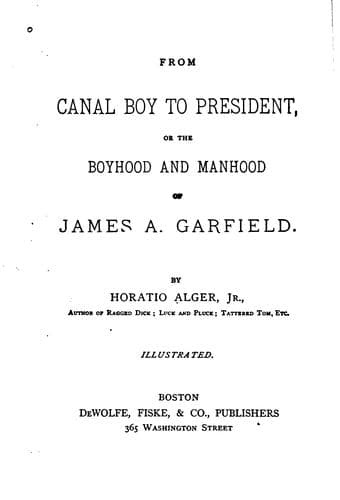
From Canal Boy to President; Or, the Boyhood and Manhood of James A. GarfieldAlger, Horatio, Jr.
History
From Canal Boy to President; Or, the Boyhood and Manhood of James A. Garfield
Alger, Horatio, Jr.
Garfield, James A. (James Abram), 1831-1881 -- Childhood and youth; Presidents -- United States -- Biography
I do not propose to detail at tiresome length the legislative
achievements of Gen. Garfield in the new position which he was destined
to fill for eighteen years. I shall only refer to such as illustrate his
characteristic devotion to duty without special regard to his own
interests. He never hesitated to array himself in opposition to the
popular will, if he thought the people were wrong. It was not long
before an occasion came up which enabled him to assert his independence.
The country needed soldiers, and had inaugurated a system of bounties
which should tempt men to join the ranks of the country's defenders. It
was only a partial success. Some men, good and true, were led to join by
the offer of a sum which made them more at ease about the comfort of
their families, but many joined the service from mercenary
considerations only, who seized the first opportunity to desert, and
turning up in another locality, enlisted again and obtained a second
bounty. These men obtained the name of bounty-jumpers, and there was a
host of them. Yet the measure was popular with soldiers, and Congress
was unanimously in favor of it. Great was the amazement of his
fellow-members when the young member from the Nineteenth Ohio district
rose in his seat and earnestly opposed it. He objected that the policy
was ruinous, involving immense expense, while effecting little good. He
claimed that the country had a right to the service of every one of its
children at such a crisis, without hire and without reward.
But one man stood with him, so unpopular was the stand he had taken; but
it was not long before the bounty system broke down, and Garfield's
views were adopted.
Later on he had another chance to show his independence. President
Lincoln, foreseeing that at a certain date not far ahead the time of
enlistment of nearly half the army would expire, came before Congress
and asked for power to draft men into service. It met with great
opposition. "What! force men into the field! Why, we might as well live
under a despotism!" exclaimed many; and the members of Congress, who
knew how unpopular the measure would be among their constituents,
defeated it by a two-thirds vote.
It was a critical juncture. As Lincoln had said in substance, all
military operations would be checked. Not only could not the war be
pushed, but the Government could not stand where it did. Sherman would
have to come back from Atlanta, Grant from the Peninsula.
The voting was over, and the Government was despondent. Then it was that
Garfield rose, and moving a reconsideration, made a speech full of fire
and earnestness, and the House, carried by storm, passed the bill, and
President Lincoln made a draft for half a million men.
Public-domain text, read in full here on John Shaqi.
Reviews
Reviews
No reviews yet
Be the first to share your thoughts on this work.
Elsewhere in the archive
Join the Discussion
Join the discussion
Sign in to leave a comment or review.
Sign InorCreate an account