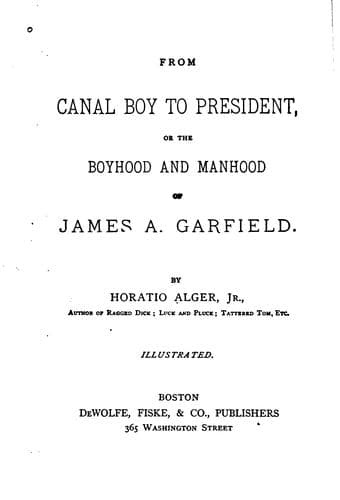
From Canal Boy to President; Or, the Boyhood and Manhood of James A. GarfieldAlger, Horatio, Jr.
History
From Canal Boy to President; Or, the Boyhood and Manhood of James A. Garfield
Alger, Horatio, Jr.
Garfield, James A. (James Abram), 1831-1881 -- Childhood and youth; Presidents -- United States -- Biography
Garfield knew that this action would be unpopular in his district. It
might defeat his re-election; but that mattered not. The President had
been assailed by the same argument, and had answered, "Gentlemen, it is
not necessary that I should be reelected, but it is necessary that I
should put down this rebellion." With this declaration the young
Congressman heartily sympathized.
Remonstrances did come from his district. Several of his prominent
supporters addressed him a letter, demanding his resignation. He wrote
them that he had acted according to his views of the needs of the
country; that he was sorry his judgment did not agree with theirs, but
that he must follow his own. He expected to live long enough to have
them all confess that he was right.
It was about this time that he made his celebrated reply to Mr.
Alexander Long, of Ohio, a fellow Congressman, who proposed to yield
everything and to recognize the Southern Confederacy.
The excitement was intense. In the midst of it Garfield rose and made
the following speech:
"MR. CHAIRMAN," he said, "I am reminded by the occurrences of this
afternoon of two characters in the war of the Revolution as compared
with two others in the war of to-day.
"The first was Lord Fairfax, who dwelt near the Potomac, a few miles
from us. When the great contest was opened between the mother country
and the colonies, Lord Fairfax, after a protracted struggle with his own
heart, decided he must go with the mother country. He gathered his
mantle about him and went over grandly and solemnly.
"There was another man, who cast in his lot with the struggling
colonists, and continued with them till the war was well-nigh ended. In
an hour of darkness that just preceded the glory of the morning, he
hatched the treason to surrender forever all that had been gained to the
enemies of his country. Benedict Arnold was that man!
"Fairfax and Arnold find their parallels of to-day.
"When this war began many good men stood hesitating and doubting what
they ought to do. Robert E. Lee sat in his house across the river here,
doubting and delaying, and going off at last almost tearfully to join
the army of his State. He reminds one in some respects of Lord Fairfax,
the stately Royalist of the Revolution.
Public-domain text, read in full here on John Shaqi.
Reviews
Reviews
No reviews yet
Be the first to share your thoughts on this work.
Elsewhere in the archive
Join the Discussion
Join the discussion
Sign in to leave a comment or review.
Sign InorCreate an account