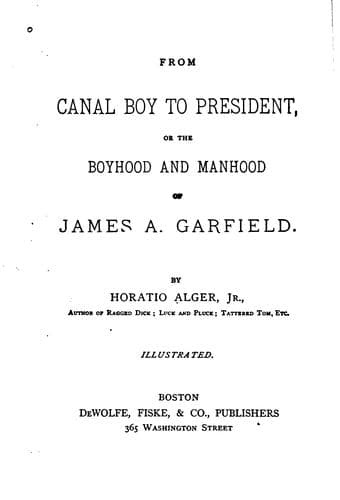
From Canal Boy to President; Or, the Boyhood and Manhood of James A. GarfieldAlger, Horatio, Jr.
History
From Canal Boy to President; Or, the Boyhood and Manhood of James A. Garfield
Alger, Horatio, Jr.
Garfield, James A. (James Abram), 1831-1881 -- Childhood and youth; Presidents -- United States -- Biography
When he heard the wild cries for "Vengeance!" and noticed the swaying,
impassioned movements of the crowd, he saw the danger that menaced the
public order, and in a moment of inspiration he rose, and with a gesture
challenged the attention of the crowd. What he said he could not have
told five minutes afterward. "I only know," he said afterward, "that I
drew the lightning from that crowd, and brought it back to reason."
CHAPTER XXIX.
GARFIELD AS A LAWYER.
In the crowded activities of Garfield's life, my readers may possibly
have forgotten that he was a lawyer, having, after a course of private
study during his presidency of Hiram College, been admitted to the bar,
in 1861, by the Supreme Court of Ohio. When the war broke out he was
about to withdraw from his position as teacher, and go into practice in
Cleveland; but, as a Roman writer has expressed it, "Inter arma silent
leges." So law gave way to arms, and the incipient lawyer became a
general.
When the soldier put off his armor it was to enter Congress, and instead
of practicing law, Garfield helped to frame laws.
But in 1865 there came an extraordinary occasion, which led to the Ohio
Congressman entering upon his long delayed profession. And here I quote
from the work of Major Bundy, already referred to: "About that time
that great lawyer, Judge Jeremiah S. Black, as the attorney of the Ohio
Democrats who had been opposing the war, came to his friend Garfield,
and said that there were some men imprisoned in Indiana for conspiracy
against the Government in trying to prevent enlistments and to encourage
desertion. They had been tried in 1864, while the war was going on, and
by a military commission sitting in Indiana, where there was no war,
they had been sentenced to death. Mr. Lincoln commuted the sentence to
imprisonment for life, and they were put into State's prison in
accordance with the commutation. They then took out a writ of _habeas
corpus_, to test the constitutionality and legality of their trial, and
the judges in the Circuit Court had disagreed, there being two of them,
and had certified their disagreement to the Supreme Court of the United
States. Judge Black said to Garfield that he had seen what Garfield had
said in Congress, and asked him if he was willing to say in an argument
in the Supreme Court what he had advocated in Congress.
"To which Garfield replied: 'It depends on your case altogether.'
"Judge Black sent him the facts in the case--the record.
"Garfield read it over, and said: 'I believe in that doctrine.'
"To which Judge Black replied: 'Young man, you know it is a perilous
thing for a young Republican in Congress to say that, and I don't want
you to injure yourself.'
"Said Garfield: 'It does not make any difference. I believe in English
liberty, and English law. But, Judge Black, I am not a practitioner in
the Supreme Court, and I never tried a case in my life anywhere.'
"'How long ago were you admitted to the bar?' asked Judge Black.
Public-domain text, read in full here on John Shaqi.
Reviews
Reviews
No reviews yet
Be the first to share your thoughts on this work.
Elsewhere in the archive
Join the Discussion
Join the discussion
Sign in to leave a comment or review.
Sign InorCreate an account