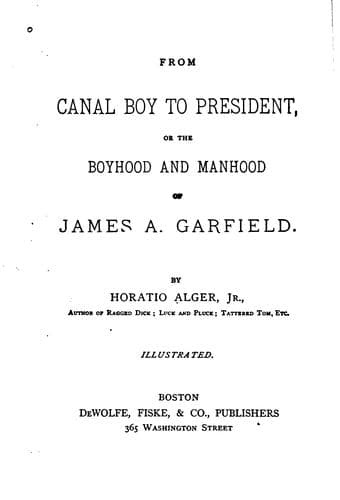
From Canal Boy to President; Or, the Boyhood and Manhood of James A. GarfieldAlger, Horatio, Jr.
History
From Canal Boy to President; Or, the Boyhood and Manhood of James A. Garfield
Alger, Horatio, Jr.
Garfield, James A. (James Abram), 1831-1881 -- Childhood and youth; Presidents -- United States -- Biography
"'Just about six years age.'
"'That will do,' Black replied, and he took Garfield thereupon over to
the Supreme Court and moved his admission.
"He immediately entered upon the consideration of this important case.
On the side of the Government was arrayed a formidable amount of legal
talent. The Attorney-General was aided by Gen. Butler, who was called in
on account of his military knowledge, and by Henry Stanbury. Associated
with Gen. Garfield as counsel for the petitioners were two of the
greatest lawyers in the country--Judge Black and Hon. David Dudley
Field, and the Hon. John E. McDonald, now Senator from Indiana. The
argument submitted by Gen. Garfield was one of the most remarkable ever
made before the Supreme Court of the United States, and was made under
circumstances peculiarly creditable to Garfield's courage, independence,
and resolute devotion to the cause of constitutional liberty--a devotion
not inspired by wild dreams of political promotion, for at that time it
was dangerous for any young Republican Congressman to defend the
constitutional rights of men known to be disloyal, and rightly despised
and hated for their disloyal practices."
I refer any of my maturer readers who may desire an abstract of the
young lawyer's masterly and convincing argument, to Major Bundy's
valuable work, which necessarily goes more deeply into such matters than
the scope of my slighter work will admit. His argument was listened to
with high approval by his distinguished associate counsel, and the
decision of the Supreme Court was given unanimously in favor of his
clients.
Surely this was a most valuable _debut_, and Garfield is probably the
first lawyer that ever tried his first case before that august tribunal.
It was a triumph, and gave him an immediate reputation and insured him a
series of important cases before the same court. I have seen it stated
that he was employed in seventeen cases before the Supreme Court, some
of large importance, and bringing him in large fees. But for his first
case he never received a cent. His clients were poor and in prison, and
he was even obliged to pay for printing his own brief. His future
earnings from this source, however, added materially to his income, and
enabled him to install his family in that cherished home at Mentor,
which has become, so familiar by name to the American people.
I can not dwell upon Garfield's experience as a lawyer. I content myself
with quoting, from a letter addressed by Garfield to his close friend,
President Hinsdale, of Hiram College, the account of a case tried in
Mobile, which illustrates his wonderful industry and remarkable
resources.
Public-domain text, read in full here on John Shaqi.
Reviews
Reviews
No reviews yet
Be the first to share your thoughts on this work.
Elsewhere in the archive
Join the Discussion
Join the discussion
Sign in to leave a comment or review.
Sign InorCreate an account